

Too Busy to Read? We’ve Got You.
Get this blog post’s insights delivered in a quick audio format — all in under 10 minutes.
This audio version covers: Westpac Drops Its Double-Hike Call as CPI Eases to 3.8%: What Big Four Consensus Means for Brokers

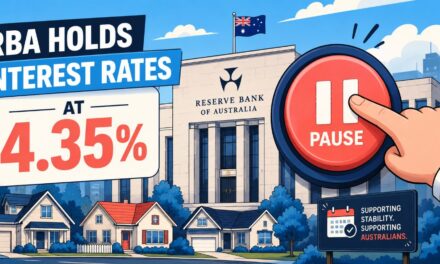
The last hawk has folded. On Wednesday 29 July, the Australian Bureau of Statistics published June CPI at 3.8 per cent annually — down from 4.0 per cent in May and under both market and RBA forecasts. Within hours Westpac abandoned its call for two more cash rate hikes, leaving all four majors expecting the RBA to sit at 4.35 per cent through the rest of 2026. For brokers, twelve months of “nobody knows” just became a single number you can plan around.
Key Takeaways
- Headline CPI eased to 3.8 per cent in the year to June 2026, down from 4.0 per cent in May. Monthly CPI actually fell 0.1 per cent in June.
- Trimmed mean held at 3.6 per cent — still above the 2–3 per cent target, but under the 3.7 per cent both the market and the RBA had penciled in.
- Westpac scrapped its August and September hike calls, with chief economist Luci Ellis saying inflation “has been more benign than we feared and the RBA forecast.”
- ANZ, NAB and CBA all reaffirmed a hold at 4.35 per cent for the balance of 2026 — the first unanimous Big Four position in over a year.
- Consensus is a ceiling, not a cut. November remains a live hike risk if Q3 inflation reaccelerates, and no major has easing before the second half of 2027.
In this article
- The Print: What the ABS Actually Released
- Westpac Capitulates: Inside the Reversal
- The Big Four Align on One Number
- The November Asterisk: Why “No Hikes” Isn’t “All Clear”
- Housing Is Still the Problem Child
- What This Means for Brokers
- Fixed vs Variable When the Peak Is In
- The Refinance Window Consensus Just Opened
- Your Next 14 Days: A Pre-11-August Action List
- The Bottom Line
The Print: What the ABS Actually Released
Headline CPI rose 3.8 per cent over the twelve months to June 2026, easing from 4.0 per cent in May. On a monthly basis, CPI edged down 0.1 per cent in June in both original and seasonally adjusted terms — a small number that carries disproportionate signalling weight after a year of upside surprises.
The RBA’s preferred measure, trimmed mean inflation, came in at 3.6 per cent annually, unchanged from May. That still sits above the 2–3 per cent target band. But it landed below the 3.7 per cent that both the market and the RBA itself had forecast, and on a quarterly basis the trimmed mean printed 0.8 per cent — softer than expected.
Where the pressure still sits
The strongest contributions to headline inflation came from:
- Housing — up 6.8 per cent, accelerating from 6.5 per cent
- Food and non-alcoholic beverages — up 3.3 per cent
- Recreation and culture — up 3.3 per cent
Goods inflation moderated to a four-month low of 3.5 per cent, with transport costs rising at their slowest pace in four months on the back of falling fuel prices. ABS head of price statistics Rachael McCririck noted that once large individual movements were stripped out, core inflation had effectively plateaued.
Westpac Capitulates: Inside the Reversal
Westpac had been the market’s most hawkish major. As recently as the week prior it was forecasting two further hikes — August and September — that would have carried the cash rate to 4.85 per cent. The June print killed that view outright.
“We no longer expect rate hikes by the RBA this year. Inflation has been more benign than we feared and the RBA forecast,” Westpac chief economist Luci Ellis said.
The core of Westpac’s hawkishness had been a call on second-round effects from the energy price shock tied to the Middle East conflict. That transmission simply did not materialise at the scale the bank expected.
“The substantial pass-through of higher energy costs seen in the early phase of the Middle East conflict has not been followed up in recent months,” Ellis said. “This is welcome — we took no pleasure in our prior hawkish view on pass-through, and so monetary policy.”
It is worth reading that second sentence twice. An economist publicly noting they are glad to have been wrong is not a rhetorical flourish; it is a signal about how much conviction sat behind the original call and how quickly the data dismantled it.
The Big Four Align on One Number
With Westpac’s reversal, ANZ, NAB and CBA now share the same base case: the cash rate stays at 4.35 per cent for the remainder of 2026.
ANZ was direct: “Today’s softer-than-expected Q2 trimmed mean inflation print of 0.8 per cent q/q should see the RBA keep rates on hold at its August meeting.” Its base case is a hold at 4.35 per cent before 50 basis points of easing in the second half of 2027.
CBA read it the same way. “Overall, today’s data support our view that the RBA will remain on hold through the rest of 2026,” the bank said, adding that the result “provides some reassurance that higher input costs are not passing through broadly and that inflation may be improving slightly faster than our forecasts.”
NAB was more guarded, flagging that the quarterly data may already be stale. “The Q2 data feels a bit more dated than usual. Cost pressures have re-emerged over recent weeks, but at the same time, indicators of domestic capacity pressures have eased a little,” it said. NAB still expects a hold this year, with easing from mid-2027, but continues to name geopolitics as the swing factor: “Ongoing conflict in the Middle East remains a threat to inflation, inflation expectations and hence the policy rate outlook.”
RBA Assistant Governor Sarah Hunter described the reading as “a touch softer” than expected, noting headline inflation has continued to ease while underlying pressures — particularly housing and services — remain persistent.
The November Asterisk: Why “No Hikes” Isn’t “All Clear”
Here is where brokers need to be careful with how they translate this to clients. Unanimous consensus on a hold is not the same as a cutting cycle, and every major attached the same caveat.
Westpac: “There is still a risk of a hike in November if inflation picks up again in Q3. But that is not our base case.” ANZ echoed it almost word for word, noting the trajectory of the monthly trimmed mean “does suggest that there remains the risk of a rate hike in November.”
Two things follow from that. First, the September quarter CPI — landing in late October, ahead of the November meeting — is now the single most important data point on the calendar for your pipeline. Second, and more consequentially for client planning: no major bank has relief priced before the second half of 2027. Westpac’s unwind assumption still starts August 2027 and was not shifted by this data.
A borrower who hears “the banks say no more hikes” and translates that into “rates are about to come down” has misunderstood the news by roughly twelve months. That gap is yours to close.
Housing Is Still the Problem Child
The 6.8 per cent housing figure deserves its own attention because it sits directly in your clients’ path. Annual inflation for new dwellings hit 5.8 per cent — the highest level in almost three years. McCririck attributed this to “builders passing on higher material and labour costs.”
For brokers, this is not an abstract line item:
- Construction and off-the-plan files face genuine cost-escalation risk between approval and completion. Build contracts written on 2025 assumptions are being tested.
- Valuation shortfalls become more likely where a fixed-price contract has been renegotiated mid-build.
- First home buyers targeting new stock are watching their deposit gap widen even as their savings grow.
The disinflation story is real, but it is being carried by goods and fuel. The domestic, sticky, services-and-shelter component is not co-operating — which is precisely why the RBA is holding rather than cutting.
What This Means for Brokers
The practical shift is that ambiguity has collapsed. For most of the past year, the honest answer to “what are rates going to do?” was a shrug dressed up in caveats. As of this week, you can give clients a defensible, sourced position: four major banks, one forecast, cash rate flat at 4.35 per cent into 2026’s close, with easing not expected until the back half of 2027.
That changes three conversations immediately:
1. The “wait and see” client
Anyone who parked a purchase or refinance in anticipation of imminent rate movement now has no reason to keep waiting. The peak, on current consensus, is in. Waiting another twelve months for a possible 2027 cut costs them twelve months of repayments at today’s rate and twelve months of market movement.
2. The stressed borrower
Households that have absorbed the recent tightening cycle can now be told, credibly, that the pressure is unlikely to increase further this year. That is a materially different hardship conversation than one held under the threat of two more hikes. Certainty of ceiling has real value in a budget.
3. The investor on the sidelines
Serviceability assessments built on an assumption of further hikes can be revisited. Nothing changes in the 3 per cent APRA buffer — but client-side risk appetite shifts when the tail scenario is removed.
Fixed vs Variable When the Peak Is In
Expect the fixed-rate question to resurface with force over the next fortnight. The framing that holds up under Best Interest Duty scrutiny is this: consensus says no further hikes, and no cuts until H2 2027. That combination argues that fixed pricing has largely already absorbed the outlook — you are not fixing to dodge an incoming hike, because the market no longer expects one.
What actually decides it is the client’s circumstances, not the forecast:
- Certainty need — a borrower with no repayment headroom may value a locked repayment regardless of where the curve sits.
- Flexibility need — offset usage, planned lump sums, or a likely sale inside the term all argue against fixing.
- Break-cost exposure — if easing genuinely arrives in H2 2027, a three-year fix taken now sits through the first cuts.
- Split structures — still the honest answer for clients who cannot articulate which of the above dominates.
Whatever you recommend, document the reasoning against the client’s stated objectives, not against your rate view. A forecast is not a basis for advice; a client’s need for certainty is.
The Refinance Window Consensus Just Opened
Lenders have been competing hard on new-business pricing while existing borrowers drift. Big Four consensus on a flat cash rate strips away the last excuse for a client to defer a repricing conversation — there is no pending RBA move to “wait for.”
Run your back book with this filter:
- Loans settled before the tightening cycle that have never been repriced
- Clients who explicitly deferred in the last six months pending a rate decision
- Fixed loans rolling to revert rates in the next two quarters
- Investor files where a lender has quietly moved its assessment settings since the client’s last review
The pitch writes itself: the rate outlook is now settled, your rate probably isn’t, and there is no reason left to wait.
Your Next 14 Days: A Pre-11-August Action List
The RBA hands down its next decision at 2:30pm on 11 August. Between now and then:
- Send a short client update this week. Two paragraphs: CPI eased to 3.8 per cent, all four majors now expect a hold, cuts are not expected until H2 2027. Being first to explain it is worth more than being thorough.
- Rebuild your “waiting” list. Pull every file parked in the last six months pending a rate decision and call them before 11 August, not after.
- Pre-brief your fixed-rate conversations. Have the H2 2027 easing assumption and the November risk written down so the answer is consistent across your team.
- Flag construction files. New dwelling inflation at 5.8 per cent means cost escalation and valuation risk. Check any build contract signed on 2025 pricing.
- Diarise the Q3 CPI release. Late October, ahead of the November meeting. That is where the consensus either firms up or breaks.
- Update your compliance file language. If your BID notes reference “expected further increases,” that assumption is now stale.
The Bottom Line
The June CPI print did something rarer than move a number: it moved a view. Westpac, the most hawkish of the majors, abandoned a two-hike call in a single session, and the Big Four now sit on the same forecast for the first time in more than a year. For brokers, that converts the rate outlook from a liability in client conversations into an asset — you can finally say something specific and stand behind it.
But hold the line on what the consensus actually says. The ceiling is in; the floor is a long way off. Trimmed mean inflation is still 3.6 per cent against a 2–3 per cent target, housing is running at 6.8 per cent, and every major attached a November caveat to their own forecast. Brokers who sell “no more hikes” as “cuts are coming” will be having an uncomfortable conversation by Christmas.
Watch two things: the RBA’s 11 August decision and accompanying statement for how Hunter’s “persistent” underlying pressures are characterised, and the September quarter CPI in late October. If Q3 reaccelerates, November comes back into play and this week’s consensus lasts exactly three months.
Sources: Australian Bureau of Statistics — Consumer Price Index, Australia, June 2026; The Adviser — “Westpac scraps double hike call as CPI drops”; MacroBusiness — “Inflation undershoot tempers RBA rate hike expectations”; Reserve Bank of Australia — Monetary Policy Decisions.
Disclaimer: This article is for general information and professional development purposes only. It does not constitute legal, compliance, or financial advice. Brokers should consult their aggregator’s compliance team and, where required, seek independent legal advice regarding their obligations under the National Consumer Credit Protection Act 2009 and ASIC’s responsible lending guidelines.