
Too Busy to Read? We’ve Got You.
Get this blog post’s insights delivered in a quick audio format — all in under 10 minutes.
This audio version covers: The 12 May Cut-Off: Seven Lenders Have Rewritten Investor Serviceability — Act Before 12 July

In this guide
What the Budget Actually Changed
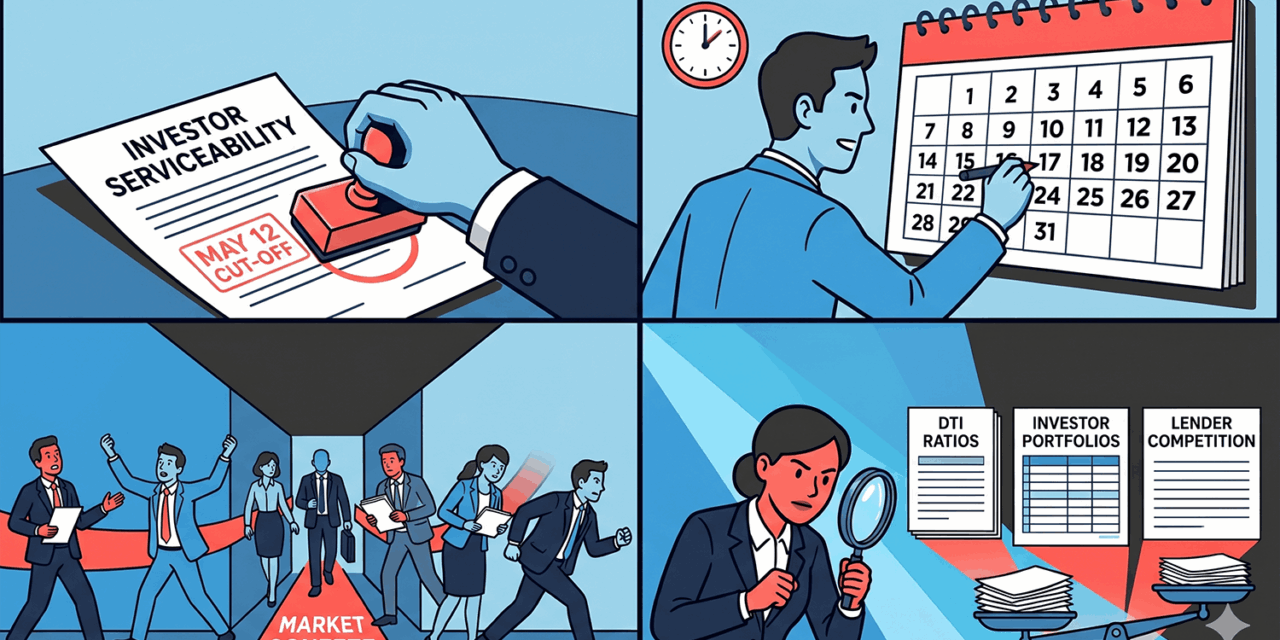
The 2026-27 federal budget, handed down on 12 May, announced a significant reform to negative gearing: from that date, the full tax deductibility of interest expenses on residential investment properties would be limited to new builds only. Existing or established properties purchased after 12 May would no longer qualify for the same treatment. The legislation is yet to pass parliament, but lenders have not waited — they have already moved to reflect the proposed changes in how they assess investor loan serviceability.
The practical effect is substantial. Prior to the budget, lenders would factor projected negative gearing tax benefits into a borrower’s serviceability calculation upfront — effectively boosting the amount they could borrow before a single tax return was lodged. Under the new framework, for established properties purchased after 12 May, that benefit disappears from the serviceability equation entirely. Interest expenses are now capped at rental income for serviceability purposes, removing the buffer that made many investor portfolios viable at higher borrowing levels.
Why It Matters
A RedZed survey of nearly 200 brokers found that 85% expect the budget changes to materially impact property prices — and those brokers are already seeing it in the borrowing power calculations crossing their desks.
Who Has Changed Their Policy — and When
The speed at which lenders have moved is notable. In order of announcement:
- CBA — emailed brokers on 28 May, effective immediately for new applications on established properties after 12 May.
- NAB — tightened investor lending to limit negative gearing recognition to new-build stock for new applications.
- ANZ — followed shortly after with a similar approach, removing the add-back for established properties.
- Macquarie Bank — removed most negative-gearing add-backs from its serviceability calculator.
- Great Southern Bank — updated investor serviceability policy in line with the budget changes.
- Suncorp — similarly aligned its investor lending policy with the 12 May cut-off.
- ING — the latest to update, effective 12 June, bringing the total to seven major lenders.
Every one of Australia’s four major banks is now aligned. Non-bank lenders and smaller ADIs are watching closely, with some yet to announce. Brokers should not assume a lender’s silence means they have not changed — confirm directly before submitting investor applications.
ING Policy Clarification
“ING’s policy draws a clear line at 12 May. Properties purchased on or before that date retain their existing treatment — negative gearing can still be factored into serviceability assessments as before.” — Australian Broker, 12 June 2026
The Pipeline Problem: Understanding the 12 July Deadline
For most brokers, the immediate priority is not new investor business — it is the existing pipeline. The transitional rules vary slightly by lender, but the ING framework (which is broadly representative of the approach taken by others) sets out the key mechanics:
- Pre-approvals converting to full approvals will be assessed under the new rules where the property is an established residential property purchased after 12 May.
- Conditional or unconditional approvals submitted for minor administrative changes — a spelling correction, a date update — on or before 12 July will not be reassessed. The original approval stands. After 12 July, the same file will be subject to the updated serviceability treatment.
- Any application resubmitted with material changes — including loan amount, repayment type, or security — will be assessed under the updated policy regardless of timing. The date of resubmission does not matter; the nature of the change does.
Critical Deadline Note
The 12 July date is not a universal industry standard — it is ING’s specific window. Check your other lenders’ transitional rules carefully. But the underlying principle is the same across the board: act now on any in-flight investor files before the window closes.
What This Means for Portfolios — Not Just Individual Properties
One of the more complex scenarios brokers are encountering is the client with a mixed portfolio — some established properties purchased before 12 May, some after. The treatment here requires careful modelling.
ING’s approach illustrates the challenge: where total interest expense across the entire portfolio exceeds total rental income after shading, the negative gearing benefit is capped at rental income for serviceability purposes. In practical terms, this means a client who has one pre-12 May property and one post-12 May property cannot assume the old property “covers” the new one. The portfolio is assessed as a whole, and any net negative position is restricted.
Brokers should model total portfolio cash flow position — not just individual property performance — before submitting any investor file that includes a post-budget purchase. The gap between pre-change and post-change borrowing capacity can be significant, and a file that would have passed serviceability a month ago may not clear it today.
Actionable Insight
It is also worth noting that ING’s online serviceability calculator was still being updated as of mid-June. Rely on manual modelling or direct BDM confirmation rather than the calculator until you receive notice that it has been updated.
The Best Interest Duty Dimension
Brokers have obligations under ASIC’s Best Interest Duty to recommend loans that are in the client’s best interest — which now requires a clear understanding of how each lender is applying the new serviceability rules and which lender may still offer the strongest outcome for a specific investor scenario.
The policy divergence between lenders — particularly between the major banks who have all updated, and some non-bank lenders who have not yet moved — creates a genuine serviceability gap that is relevant to lender selection. A client purchasing an established investment property after 12 May may achieve a higher maximum borrowing capacity with a non-bank lender that has not yet updated its policy. That is a legitimate factor in your lender recommendation, provided the overall recommendation still meets BID requirements.
ASIC Compliance Note
Document your reasoning clearly. In an environment where ASIC is monitoring lender and broker behaviour around credit policy changes, a clear file note explaining why you selected a particular lender for an investor client — and how you assessed the serviceability position across multiple options — is essential risk management, not optional paperwork.
Broker Action Checklist: What to Do This Week
- Audit your entire investor pipeline. For every investor file currently in progress, confirm the property type (new build or established), the contract date (before or after 12 May), and which lender the application is lodged with.
- Check each lender’s transitional rules. Do not assume the 12 July deadline applies universally. Confirm the specific window with each lender’s BDM or credit team.
- Identify material versus minor changes. Any file that might need material changes — loan amount, security, repayment type — will be reassessed under the new rules regardless of when it is resubmitted. Plan accordingly.
- Re-model mixed portfolios. If a client holds both pre- and post-budget properties, model the entire portfolio position before resubmitting, not just the new property.
- Check non-bank options for post-budget purchases. Where the major bank serviceability outcome is constraining for an established property, assess whether a non-bank lender that has not yet moved offers a compliant and better-suited solution.
- Brief your investor clients proactively. Clients who purchased after 12 May need to understand their borrowing capacity has changed — before they make commitments on their next purchase. A proactive conversation now prevents a difficult conversation at settlement.
- Document lender selection reasoning in your file notes. Given the serviceability variation across lenders right now, your BID file notes should explicitly address why the chosen lender offered the best outcome for this client under the current policy settings.
What to Watch Next
The legislation underpinning these changes has not yet passed parliament as of late June. If the bill is amended or delayed, some lenders may revisit their serviceability positions — though that appears unlikely given the bipartisan support the reforms have received. Watch for:
- Non-bank lender announcements — several have not yet published updated policy positions
- APRA guidance on how the changes interact with its existing DTI limits (particularly for high-DTI investor applications that are already capped under the 20% rule)
- Any Senate committee amendments that might alter the 12 May cut-off date or the definition of “new build”
- Lender calculator updates — confirm with each lender when their online tools reflect the new settings before relying on them for formal submissions
Act Now: Navigate the New Investor Lending Landscape
The negative gearing serviceability sweep is the most significant shift in investor lending policy since APRA introduced its macroprudential controls, and it has happened faster than most brokers anticipated. Seven major lenders have aligned in six weeks. The 12 July deadline on transitional approvals is the immediate operational pressure point, but the structural change — reduced borrowing capacity for established property investors — is here to stay, at least until the legislation is formally settled.
Brokers who get ahead of this now — by auditing their pipelines, re-modelling client positions, and understanding the lender-by-lender variation — will avoid the uncomfortable conversations that come with last-minute serviceability surprises. Those who don’t may find their investor clients’ deals unravelling at the worst possible time.
The market has changed. The question is whether your process has changed with it.
Secure Your Investor Deals Before the Deadline
Sources: Australian Broker — ING joins major lenders in cutting negative gearing serviceability; The Adviser — CBA hard-wires negative gearing changes into servicing; Australian Broker — More lenders tighten investor lending rules ahead of tax shake-up
Disclaimer: This article is for general information and professional development purposes only. It does not constitute legal, compliance, or financial advice. Brokers should consult their aggregator’s compliance team and, where required, seek independent legal advice regarding their obligations under the National Consumer Credit Protection Act 2009 and ASIC’s responsible lending guidelines.