
Too Busy to Read? We’ve Got You.
Get this blog post’s insights delivered in a quick audio format — all in under 10 minutes.
This audio version covers: Offshore Loan Processors vs. Agentic AI The 2026 Cost-Benefit Analysis for Scaling Brokerages

Offshore Loan Processors vs. Agentic AI: The 2026 Cost-Benefit Analysis for Scaling Brokerages
The Australian mortgage landscape in 2026 presents a significant dichotomy between market dominance and operational vulnerability. While the broker channel has successfully secured a record 77.3% to 78% share of all new residential mortgages [1, 2], the underlying commercial viability of the brokerage model is being tested by a convergence of aggregator margin compression, lender net interest margin (NIM) pressure, and a radical shift in regulatory expectations.[3, 4, 5]
Inside This Strategy Briefing
- Step 1: Macroeconomic Drivers of Transformation
- Step 2: The Offshore Processing Paradigm
- Step 3: The Rise of Agentic AI Workflows
- Step 4: Navigating the March 2026 Compliance Shift
- Step 5: The 2026 Operational Playbook
As lenders pivot toward proprietary digital strategies to recapture customer relationships and protect their profitability, the modern Australian brokerage faces a critical strategic juncture: how to scale operations without a linear increase in overhead.[1] The choice between the traditional offshore processing model and the emerging agentic AI framework has moved beyond a simple technology preference to become the defining factor in a firm’s long-term commercial resilience.
Step 1: Macroeconomic Drivers of Transformation
The pressure to innovate is largely driven by the erosion of traditional profit centers within the mortgage value chain. Australian banks, facing historically low net interest margins, are implementing riskier strategies, which in some cases include relaxed credit assessments and aggressive marketing toward higher-risk products.[3]
2026 Market Alert: The New Zealand market served as a precursor when Westpac NZ announced the abolition of trail commissions in late 2025, moving instead to a higher upfront-only model of 0.90%.[6] This structural change, designed to remove long-term liabilities from the bank’s balance sheet, has fueled widespread speculation that similar models may be considered by Australian parent entities as NIM pressures continue to mount.[6]
Step 2: The Offshore Processing Paradigm
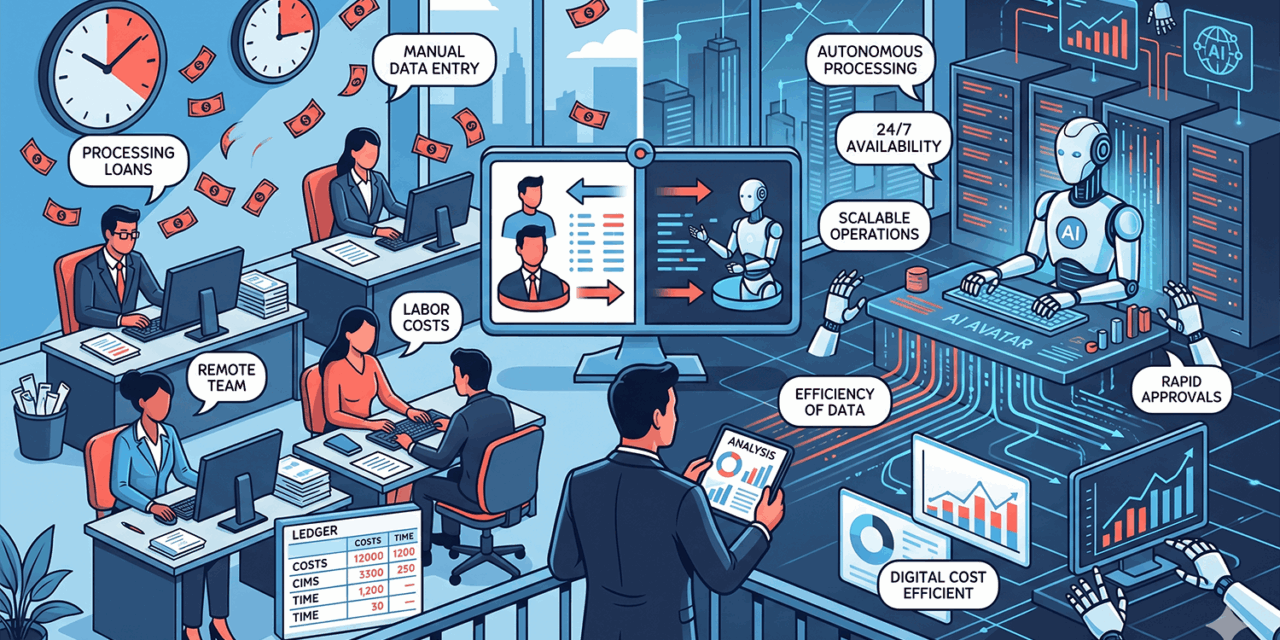
Offshore loan processing remains the primary scaling engine for Australian brokerages seeking to reduce labor costs. By 2026, the model has matured, with hubs in the Philippines and South Asia providing specialized support that extends beyond data entry to include comprehensive file packaging, serviceability checks, and lender liaison.[7, 8]
The Economic Logic of Labor Arbitrage
The fundamental appeal of the offshore model lies in the significant labor cost arbitrage. In 2026, a senior mortgage loan processor in a primary offshore hub costs between 50% and 70% less than a comparable onshore hire in Australia.[9, 7]
| Resource Location | Average Annual Salary (AUD) | Employer On-Costs | Total Annual Cost |
|---|---|---|---|
| Australia (Onshore) | $75,000 | 20–25% | $90,000+ |
| Offshore (South Asia) | $12,000 – $18,000 | 10–15% | $14,000 – $20,000 |
Source: 2026 Offshore Cost Breakdown Analysis.[9]
Step 3: The Rise of Agentic AI Workflows
Agentic AI represents a paradigm shift from traditional “assistive” AI. While standard AI tools might flag an anomaly or summarize a document, agentic AI is characterized by “agency”—the ability to plan, reason, and execute multi-step tasks independently to achieve a specific objective.[10, 11] In 2026, this technology is being deployed as a core “elastic workforce” that can automate up to 70% of manual back-office tasks.[12, 13]
Performance Benchmarks (Live Production Outcomes)
- Cost-per-loan reduction: Institutions report per-loan processing cost reductions of 35% to 50%.[14]
- Volume Growth: Mozaiq’s agentic AI enabled a wholesale lender to scale to over $2B in monthly volume within two years.[15]
- Credit Decisioning Speed: AI analyzes borrower profiles 12x faster than manual underwriting processes.[14]
- Profitability Impact: Average increase of 20% in profit per loan through AI-driven optimization.[14]
Step 4: Navigating the March 2026 Compliance Shift
As brokerages scale through technology or offshoring, they must navigate an increasingly complex regulatory landscape. In 2026, the OAIC and ASIC have shifted from policy-focused oversight to “runtime” monitoring of how systems actually behave.[16]
The Identity Document Retention Ban
From 31 March 2026, amended record-keeping obligations under the AML/CTF Act have fundamentally changed the KYC process. Reporting entities—including mortgage brokers—should no longer retain full copies of identity documents like passports or driver’s licenses for AML/CTF purposes.[5] Instead, they must only keep specific data points to prove verification was performed.[5]
Compliance Warning: From March 2026, retaining copies of ID documents to comply with AML/CTF requirements will no longer be justified. Brokerages must ensure their record-keeping processes align with these changes or risk breaching the Privacy Act.[5]
Step 5: The 2026 Operational Playbook
For a brokerage principal, success in 2026 is not about chasing every lead but about mastering the “loan factory” through systemization.[17]
Practical Steps to Take This Week:
- Audit Your CRM: Platforms like Salestrekker 2.0 now offer tiered pricing (e.g., Premium Broker at $249.99/mo) that includes “Salestrekker AI” and automated policy search.[18]
- Review Data Flows: Ensure offshore staff are not retaining PII. From March 2026, only data points (numbers/outcomes), not document copies, should be stored.[5]
- Deploy Agentic Triage: Use AI agents for “L1 Alert Triage”—the initial review of alerts or documents to determine if escalation to a human broker is necessary.[19, 10]
Mastering the Margin
The Australian mortgage broker in 2026 is no longer just an advisor; they are the orchestrator of a complex, high-velocity financial supply chain. To navigate aggregator margin compression, brokerages must abandon the “bolt-on” technology mindset in favor of a cohesive, AI-native operational model.
Download the 2026 Scaling Framework