
In this guide
What the numbers actually say
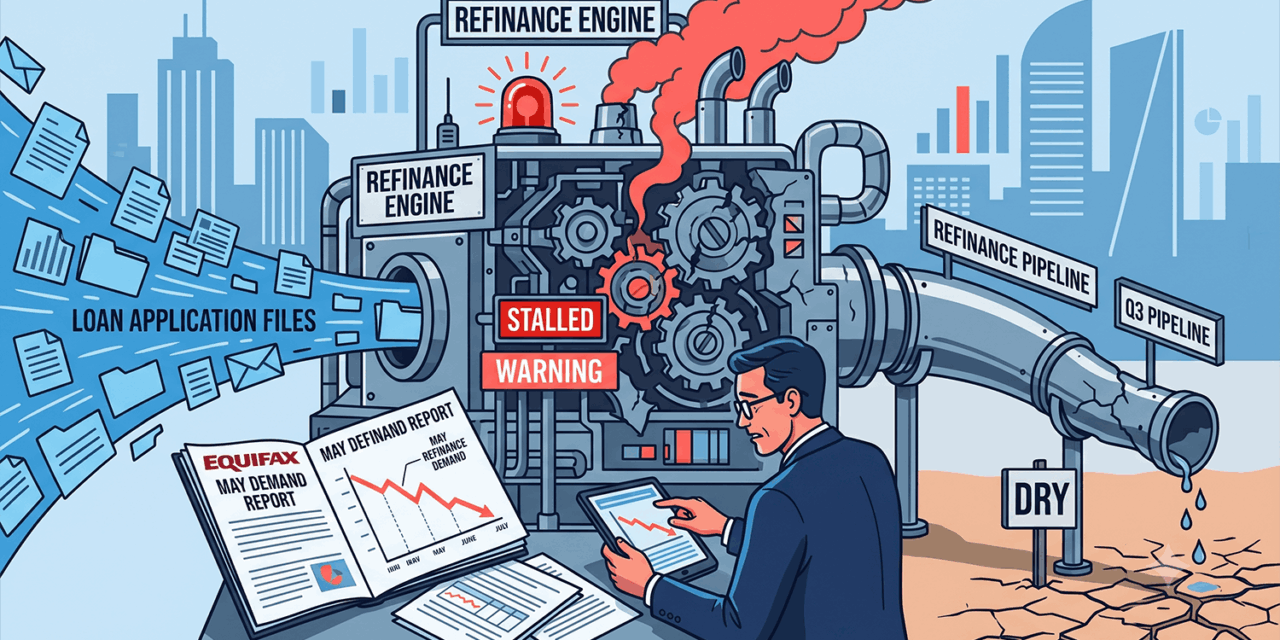
Equifax, which tracks credit enquiries right across the banking system, reported on 16 June that mortgage growth has swung from solid expansion at the start of 2026 to a broad-based contraction. Overall mortgage demand was running 10.7 per cent higher year-on-year in January. By April it had slipped to a 0.9 per cent fall. In May it dropped 6.6 per cent — a 17-percentage-point deterioration in barely five months.
The detail is where it gets uncomfortable for the broker channel. First home buyer activity, which held up surprisingly well early in the year, has cracked: from +7.1 per cent in January to -9.1 per cent in May. And refinancing — the engine that has carried broker volumes through the entire rate-hike cycle — is fading fast. Total refinancing demand was 12.4 per cent higher in January but 5.6 per cent lower by May. Same-lender refinances flipped from +16.2 per cent to -7 per cent, and external switches went from +8.6 per cent to -4.2 per cent over the same window.
Equifax executive general manager Moses Samaha put it bluntly:
“Last month I observed that we were beginning to see a ‘slight handbrake’ on mortgage demand, and this month after three successive rate hikes, the impact has well and truly hit with an observed significant decline.”
Why this matters for brokers specifically
Plenty of commentators will read these figures as a story about borrowers and the property market. Brokers should read them as a story about their own book. The broker channel writes roughly four in five new home loans in Australia, and a large slice of that flow in 2024–25 came from refinancing. When refinancing turns negative — not just slowing, but contracting year-on-year — the most reliable lead source in most brokerages quietly shrinks.
The contraction is also unusually broad. Samaha noted the weakness “started in Victoria” — which has shown negative pockets of demand since February — but has now “broadened across all states and territories at differing levels.” New FHB mortgages fell in every major state in May: down 16.2 per cent in Queensland, 15.3 per cent in Victoria, 12.3 per cent in NSW, 11.9 per cent in South Australia and 8.4 per cent in Western Australia. Refinancing fell everywhere too, led by an 11.6 per cent drop in Victoria. There is no obvious state you can lean on to backfill the gap.
By age, only one cohort grew at all: borrowers aged 65-plus, who recorded a minor 3.3 per cent uptick in switching lenders. Every working-age bracket went backwards, with 26–35-year-olds — the heart of the first-home-buyer market — down 16.3 per cent. The “expanded 5 per cent deposit guarantee” that propped up FHB demand earlier in the year has, in Samaha’s words, been “washed out by the realities of a high-rate market.”
The “mortgage prisoner” signal hiding in the refi data
The most strategically important line in the Equifax release is also the least obvious. In a normal rising-rate cycle, refinancing spikes — borrowers shop hard for a sharper deal. This time it’s doing the opposite, and Samaha thinks that tells us as much about capacity as it does about appetite:
“This drop could indicate consumer confidence is hitting a wall. Plus, with rates where they are, many people might actually be stuck. They want to refinance, but cost-of-living pressures and new loan serviceability criteria might be impacting their ability to refinance.”
Key Concept: Mortgage Prisoners
That is the “mortgage prisoner” problem, and it lands squarely in the broker’s lap. A growing pool of borrowers want to switch lenders or consolidate debt but can no longer clear an assessment at a 4.35 per cent cash rate plus a 3 per cent serviceability buffer. They are not bad leads — they are blocked leads. The broker who can either find the one lender whose policy unlocks the file, or build a 6–12 month plan to get the client refinance-ready, owns that relationship when the market turns.
How to reposition your pipeline now
If your 2026 forecast was built on refinancing carrying the load, this data is your prompt to rebalance. A few moves worth making this week:
- Re-segment your database by serviceability, not just rate. Pull your back book into three buckets: clients who can refinance and benefit, clients who want to but currently fail servicing, and clients better served by a repricing request to their existing lender. The middle bucket is your “mortgage prisoner” list — and it’s a nurture pipeline, not a dead lead.
- Lean into repricing and retention conversations. With same-lender refinancing now negative, many borrowers aren’t moving — but that doesn’t mean they shouldn’t be repriced. A proactive call to renegotiate a client’s existing rate protects the relationship, satisfies Best Interest Duty by demonstrating you’ve reviewed their position, and keeps you front of mind for when capacity frees up.
- Diversify away from rate-driven refinance volume. Brokers over-indexed on prime refinancing are most exposed to this slump. SMSF lending, commercial and asset finance, construction, and specialist or non-bank scenarios are less correlated with the consumer refi cycle and can fill the gap.
- Tighten pre-approval hygiene. With FHB demand down double digits and serviceability biting, stale pre-approvals are both a conversion risk and a Best Interest Duty exposure. Re-test live pre-approvals against current servicing calculators before clients go to auction.
- Watch the lenders, not just the borrowers. ANZ has already flagged a mortgage slowdown and Westpac has recorded a demand slip. When the majors see volumes soften, front-book pricing and cashback competition usually sharpen — which can quietly re-open refinance maths for clients who failed it a month ago.
What to watch next
The RBA held the cash rate at 4.35 per cent on 16 June, its first hold of 2026 after three consecutive hikes. That pause matters here: if the next move is a cut — as NAB now tips — serviceability buffers loosen and a chunk of today’s mortgage prisoners become refinanceable almost overnight. The brokers who used the slow patch to map that blocked pipeline will convert it fastest.
For now, treat the Equifax figures as an early-warning system rather than a verdict. Demand has contracted, but it has contracted from a high base, and the structural drivers of broker share — borrower complexity, lender policy divergence and the need for human guidance through a tighter credit environment — are all intact.
Build Relationships, Not Just Refi Waves
The job this quarter is to stop relying on the refinance wave that’s receding and start building the relationships that pay out when it returns. Proactive engagement with your “mortgage prisoner” clients and strategic diversification will position you for success, regardless of market shifts.
Explore More Broker Insights
Sources: The Adviser — “Mortgage demand in ‘significant decline’” (16 June 2026); Equifax mortgage demand data; Australian Broker; Savings.com.au.
Disclaimer: This article is for general information and professional development purposes only. It does not constitute legal, compliance, or financial advice. Brokers should consult their aggregator’s compliance team and, where required, seek independent advice regarding their obligations under the National Consumer Credit Protection Act 2009 and ASIC’s responsible lending and Best Interest Duty guidance.