

Too Busy to Read? We’ve Got You.
Get this blog post’s insights delivered in a quick audio format — all in under 10 minutes.
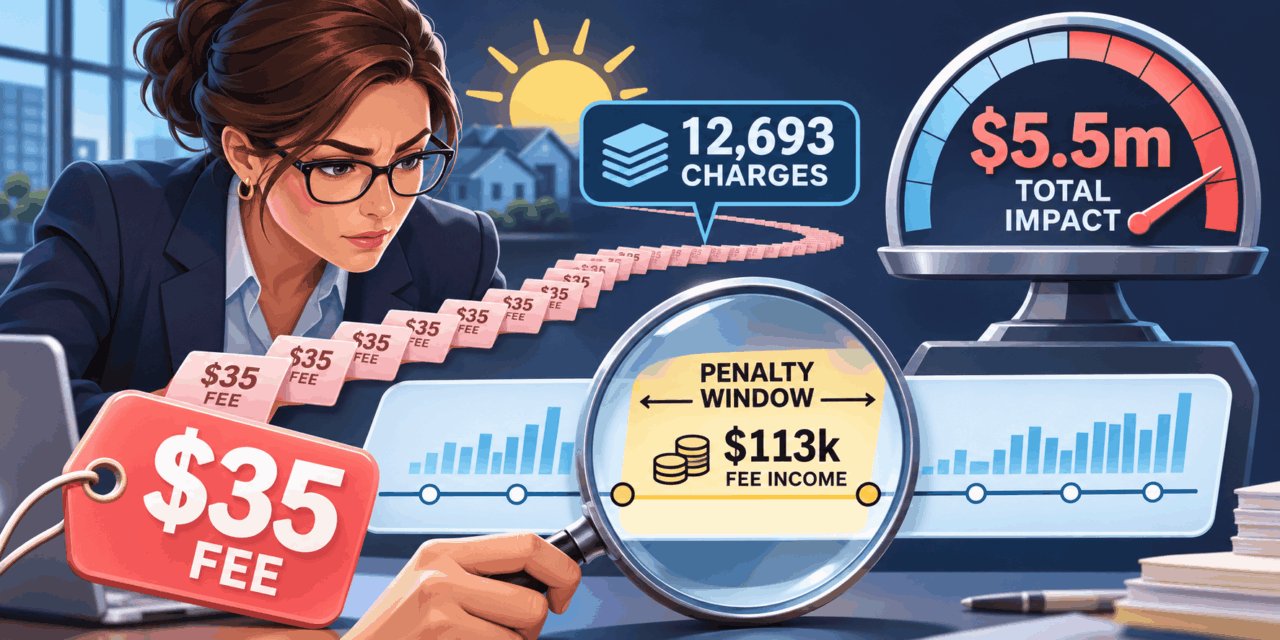
This audio version covers: A $35 Fee Charged 12,693 Times Cost Sunshine Loans $5.5m. About $113,000 of the Fee Income Sat Inside the Penalty Window

Compliance · Enforcement Snapshot
A $35 Fee, 670,609 Contracts and a $5.5 Million Penalty
ASIC announced on 6 November 2026 that the Federal Court had penalised a small amount credit lender over a single prohibited fee. The money involved was small. The penalty was not — and the reasons it was not are the part brokers should read.
The numbers as the court and ASIC set them out
The penalty is not sized to the money
What actually drove the size of it
1Repetition, not revenue
The fee term sat in every one of 670,609 contracts. Under the National Credit Code it is entering into a contract on prohibited terms that is itself the breach — before anyone is charged a cent.
2A deliberate finding
ASIC’s release says the judge found the contraventions serious and deliberate. Deliberateness moves a penalty far more than the dollar value of the conduct does.
3Conduct after the fact
ASIC’s release quotes the judge describing the company’s arguments as “devoid of merit to the point of being potentially disingenuous”, which he said indicated a poor culture of compliance.
Four years from filing to penalty
- 1 July 2016Start of the relevant period. The fee appears in the contract’s financial table as a “rescheduled payment fee” of $35, later relabelled an “amendment fee”.
- 13 March 2019The date from which civil penalties were available for this conduct. The document did not change. The exposure attached to it did.
- 2 November 2020End of the relevant period.
- June 2022ASIC commences proceedings in the Federal Court.
- 12 April 2024Liability judgment: ASIC v SunshineLoans Pty Ltd (No 2) [2024] FCA 345, Derrington J.
- 2025 – 2026The Full Federal Court and then the High Court rule in ASIC’s favour on the appeals that followed.
- 6 November 2026ASIC announces the $5.5 million civil penalty, plus its costs.
The detail that matters most: the court’s answer did not turn on the label or the amount. It turned on when the obligation to pay arose — and nothing in the contract terms conditioned this fee on a default in payment. The default and dishonour fees were each tied to a specific clause. This one was a line in a fee table with no operative clause behind it.
The broker read
Sunshine Loans is a small amount credit lender, not a broker, and the fee caps it breached do not apply to broker fees. The transferable part is the shape of the risk: a defect that lives in a template repeats across every file, the penalty tracks the repetition rather than the revenue, and section 47 of the National Consumer Credit Protection Act puts compliance with the credit legislation on every licensee — including yours.
Sources: ASIC media release 26-269MR (6 November 2026); ASIC v SunshineLoans Pty Ltd (No 2) [2024] FCA 345. Figures are as set out in those documents. General information only — not legal or compliance advice.
A $35 Fee Charged 12,693 Times Cost Sunshine Loans $5.5m. About $113,000 of the Fee Income Sat Inside the Penalty Window
The penalty is roughly 49 times the money the lender received while civil penalties were available. That multiplier was not built out of profit — it was built out of a line in a fee table with no clause behind it, repeated across 670,609 contracts.
Sunshine Loans is a small amount credit lender, not a broker, and the fee rules it breached have no application to the way brokers charge fees. Read it anyway. The shape of the exposure — a template defect that repeats on every file, and a penalty sized to the repetition rather than the revenue — is available to any credit licensee, including yours.
In this article
On 6 November, ASIC announced that the Federal Court had ordered Sunshine Loans Pty Ltd to pay $5.5 million in civil penalties, plus ASIC’s costs, over a $35 fee.
Across the whole period in question — 1 July 2016 to 2 November 2020 — the company received $293,160 from that fee. ASIC’s release puts the amount received inside the window in which civil penalties were actually available at about $113,000. The penalty is roughly 19 times the first figure and roughly 49 times the second.
That ratio is the reason this matter is worth a broker’s attention. A penalty that lands at 49 times the money involved was not calculated from the money. It was calculated from how many times one document defect repeated, from a finding that the conduct was deliberate, and from how the company behaved once it was challenged. All three of those drivers are available to a brokerage with a fee sitting in a template and no clause standing behind it.
What the court decided
The fee started life in the contract’s financial table as a “rescheduled payment fee” of $35.00, listed under the heading “other fees and charges retained by us”. Later versions of the document relabelled it an “amendment fee”. It was charged when a borrower asked to move a repayment date, including where the borrower was not in default.
Small amount credit contracts sit under a strict fee regime in the National Credit Code. The permitted categories are narrow, and the one the lender needed was s 31A(1)(c), which allows “a fee or charge that is payable in the event of a default in payment under the contract”. In the liability judgment — Australian Securities and Investments Commission v SunshineLoans Pty Ltd (No 2) [2024] FCA 345, delivered by Derrington J on 12 April 2024 — the court held the amendment fee did not fit that category. The obligation to pay it arose because the parties agreed to vary the loan, not because the borrower had defaulted.
The court drew the line tightly: a fee of that kind has to be conditioned on a default in payment on every occasion. An event that merely happens to occur while a borrower is in default is not enough by itself.
Once the fee was prohibited, the rest followed. It became a monetary liability prohibited by s 23A(1), which engaged s 24(1A) of the Code: a credit provider must not enter into a small amount credit contract on terms imposing such a liability, and must not require or accept payment of it. ASIC also pleaded s 47(1)(d) of the National Consumer Credit Protection Act 2009 — the licensee obligation to comply with the credit legislation. That last provision is the one that should hold a broker’s eye, and we come back to it below.
Why the penalty is 49 times the money
Three things drove the size of this outcome, and none of them is revenue.
First, the term rather than the transaction. On the agreed facts, 670,609 small amount credit contracts were entered into during the relevant period containing the fee. What s 24(1A)(a) prohibits is entering into a contract on terms that impose a prohibited liability. The breach is in the paper, not in the payment. The 12,693 occasions on which the fee was charged and the 8,376 occasions on which it was paid are a small subset of the contracts that carried it.
That is a different exposure model from the one most licensees carry in their heads. The instinct is to measure risk by the number of clients who were actually charged something they should not have been. Here, the population at risk was every contract written on the template.
Second, deliberateness. ASIC’s release states that the judge found the contraventions serious and deliberate. In civil penalty proceedings, a finding of that kind moves the number far more than the dollar value of the conduct does.
Third, conduct after the fact. ASIC’s release quotes the judge describing the company’s arguments as “devoid of merit to the point of being potentially disingenuous”, which he said indicated a poor culture of compliance. Reporting on the penalty judgment on 6 November, the legal publication Lawyerly said the judge gave limited weight to the company’s claim that it had relied on legal advice when it introduced the charge. That detail appears in Lawyerly’s report and not in ASIC’s media release, so treat it as that outlet’s account of the reasons rather than an established finding until the judgment itself is available.
The money was the smallest part of this. The penalty tracked the number of contracts, the finding about intent, and the posture taken in the proceedings.
The clause that wasn’t there
The most portable detail in the liability judgment is also the least dramatic. The fee appeared in the financial table. It was not explained in the contract terms. No clause said when it became payable.
The contrast the court drew was with the same document’s other fees. The default fee and the dishonour fee were each tied to specific clauses that said what triggered them. The amendment fee was a number in a table, floating free of any operative provision.
Relabelling it did not help. A “rescheduled payment fee” and an “amendment fee” are the same charge with different words on it, and the question the court asked was not what the fee was called but when and why the obligation to pay it arose. Substance over label is not a new principle. What is useful here is seeing exactly where the substance was found: in the presence or absence of a clause.
For a brokerage, the equivalent question is uncomfortably easy to ask and surprisingly hard to answer. If you charge a fee for service, a restructure, an application, a cancellation or a re-lodgement, you can almost certainly point to the amount. Can you point to the clause in the document the client signed that says what triggers it, and does that trigger match what your staff actually do?
13 March 2019
The conduct ran from July 2016. Civil penalties were only available for it from 13 March 2019, which is why about $113,000 of the $293,160 collected sits inside the penalty window and the rest does not.
Nothing about the document changed on that date. The exposure attached to it did.
Brokers have their own version of this. The best interests duty and the obligation to prioritise consumers’ interests commenced on 1 January 2021, introduced by the Financial Sector Reform (Hayne Royal Commission Response—Protecting Consumers (2019 Measures)) Act 2020 and explained in ASIC’s Regulatory Guide 273. A fee schedule, engagement letter or credit guide drafted before that date was not grandfathered by its age. If a document was written for one regulatory regime and is still being issued under another, the date on the template is a question, not a defence.
A note on what this case does and does not say. The small amount credit contract fee caps in ss 23A and 31A of the National Credit Code apply to credit providers writing those contracts. They do not set the rules for broker fees, and nothing here suggests a broker fee is prohibited.
What travels across is the general conduct obligation in s 47 and the method the court used: looking for the clause that creates the liability rather than accepting the label on the table. Whether and how any particular fee may be charged in your business depends on your authorisations and your documents — a question for your licensee or aggregator’s compliance team, or an independent legal adviser.
Where this reaches your licence
Section 47 of the National Consumer Credit Protection Act sets the general conduct obligations of credit licensees. It does not distinguish between a lender and a broker. Three of its paragraphs are worth reading alongside this case:
- s 47(1)(a) — do all things necessary to ensure that the credit activities authorised by the licence are engaged in efficiently, honestly and fairly.
- s 47(1)(d) — comply with the credit legislation. This is the provision ASIC pleaded against Sunshine Loans alongside the Code breaches.
- s 47(1)(e) — take reasonable steps to ensure that representatives comply with the credit legislation.
Paragraph (e) is the one that should concentrate the minds of anyone running a brokerage with credit representatives underneath them. A defective fee document issued under your authorisation by someone else is not someone else’s problem. It is a reasonable-steps question directed at you, and the answer lives in whether you ever checked the documents your representatives are actually handing clients, as against the ones head office approved.
If you operate as a credit representative yourself, the mirror image applies: the documents you use are your licensee’s responsibility to supervise, which means the fastest route to an answer about a fee you are charging is usually to ask them to point you to the clause.
What ASIC has said about broking
ASIC Commissioner Alan Kirkland, delivering the keynote address at the Credit Law conference on 14 October 2025, said ASIC was examining mortgage brokers’ compliance with the best interests duty and their complaints handling, together with the supervision practices of large aggregators, and that serious issues could lead to action. The same speech framed ASIC’s approach as outcomes-led rather than organised by credit type or business type — action taken wherever credit-related misconduct appears.
Read against the Sunshine Loans outcome, that framing is the relevant signal. The regulator pursued a $35 fee through a liability hearing, two appellate courts and a penalty hearing across more than four years, for a total benefit to the defendant of under $300,000. Proportionality to the money was plainly not the test being applied.
The fee-term audit
This is an hour of work for most brokerages, and it is the kind of hour that is far cheaper before anyone asks than after.
Eight checks on every fee you can charge
- List them all. Every fee your business can charge a client, including the ones nobody has charged in two years but which still sit in the schedule.
- Name the document. For each fee, identify the document the client receives or signs that discloses it — credit guide, credit proposal, fee agreement, engagement letter.
- Name the clause. Not the table. The operative clause that says what event makes the fee payable. If there isn’t one, you have found the Sunshine Loans problem in your own paperwork.
- Match the trigger to the practice. Compare the written trigger with what your team actually does. A clause that says “on lodgement” and a process that charges on first appointment are two different arrangements.
- Check the timing of disclosure. Establish when the client is told, relative to when the fee can be incurred, and whether your file records that this happened.
- Check your automation. Any fee your CRM or loan-processing workflow applies by default is the one most likely to repeat across the whole book. Automation is what turns a single defect into a population.
- Check your representatives’ versions. Pull the live documents from two or three credit representatives and compare them with the approved template. Version drift is normal and invisible until someone looks.
- Date-stamp and ask what changed. Find the date each template was last reviewed, then list the regulatory changes since. Anything written before 1 January 2021 has been through at least one regime change.
If the audit turns up a fee you cannot trace to a clause, the next step is not to quietly stop charging it. It is to take the document to your licensee or compliance adviser, because the question of what to do about fees already charged is a different and more technical one than the question of what the document should say from here.
What to watch next
Three things are worth following from here.
The published reasons. ASIC’s release summarises the judge’s findings; the penalty judgment itself will carry the reasoning on how the figure was built and on what weight reliance on legal advice attracted. For any licensee that has ever relied on an adviser’s sign-off for a document, that passage is the one to read.
ASIC’s broking surveillance. Best interests duty compliance, complaints handling and aggregator supervision were all named as areas of active attention in October 2025. Outcomes from that work are the more direct exposure for the broker channel.
Whether the method recurs. The “fee in the table, no clause in the terms” analysis is a clean and repeatable way to test a fee. If it starts appearing in other credit matters, it becomes a template for how documents get reviewed generally.
The practical significance
A broker reading the headline could reasonably conclude this is a payday lending story. It is, and the specific rules breached will never touch a mortgage file.
But the mechanics are not specific to payday lending at all. A fee was put in a template. The template was used hundreds of thousands of times. Nothing in the terms said when the fee was payable. Years later, a regulator sized a penalty against the repetition and the posture rather than the profit, and arrived at a number roughly 49 times the money received in the relevant window.
The defensible position is not having never made a documentation error. It is being able to show, on request, which document authorises each fee, which clause triggers it, when the client was told, and when the template was last reviewed against the law as it now stands. That is a file-and-template question, and it is answerable this week.
Key takeaways
- The Federal Court ordered Sunshine Loans to pay $5.5 million plus ASIC’s costs over a $35 fee that returned $293,160 in total, about $113,000 of it inside the window in which civil penalties were available.
- On the agreed facts the fee term sat in 670,609 contracts; under s 24(1A)(a) of the National Credit Code it is entering into a contract on prohibited terms that constitutes the breach, so the exposed population was the template, not the 8,376 payments.
- What took the fee outside the permitted category in s 31A(1)(c) was that the obligation to pay arose from the parties agreeing to vary the loan rather than from a default in payment — and nothing in the contract terms conditioned it on default, unlike the same document’s default and dishonour fees, which were each tied to a specific clause.
- The small amount credit fee caps do not apply to broker fees, but s 47(1) of the National Consumer Credit Protection Act applies to every credit licensee, including the obligation at (e) to take reasonable steps to ensure representatives comply with the credit legislation.
- ASIC said in October 2025 that it was examining brokers’ best interests duty compliance, complaints handling and aggregator supervision — the more direct exposure for the broker channel.
Questions brokers are asking
No. The provisions breached here are the fee caps that apply to small amount credit contracts written by credit providers. They do not govern broker fees, and nothing in the case suggests a broker fee-for-service arrangement is impermissible. The transferable point is about documentation: being able to identify the clause that makes a fee payable, and the event that triggers it. How that applies to your own arrangement is a question for your licensee or an independent legal adviser.
Because the measure was not the money. The fee term was present in 670,609 contracts, and the relevant prohibition is directed at entering into a contract on those terms, so the number of contraventions available far exceeded the number of borrowers charged. ASIC’s release also records findings that the contraventions were serious and deliberate, and the judge’s criticism of the arguments run in the proceedings as indicating a poor culture of compliance. Those factors, rather than the roughly $113,000 received in the penalty window, shaped the figure.
That is the date from which civil penalties became available for this conduct. The fee had been charged since July 2016, but only the amounts received from 13 March 2019 — about $113,000 of the $293,160 total — fell within the period for which a civil penalty could be imposed. The document did not change on that date; the consequences of using it did. It is a useful reminder that templates do not acquire protection by being old.
No. This outcome concerns the lender’s own contract terms and its own licensee obligations. It makes no finding about any broker, aggregator or intermediary, and should not be read as one. The relevance to brokers is methodological — how the court tested a fee, and which general conduct obligations sit on every credit licensee.
Breaking news for modern brokers
Compliance reads, lender policy changes and market data, written for the broker channel.
Sources: ASIC media release 26-269MR, “Sunshine Loans ordered to pay $5.5 million penalty for charging customers illegal fees” (6 November 2026); Australian Securities and Investments Commission v SunshineLoans Pty Ltd (No 2) [2024] FCA 345 (Derrington J, 12 April 2024); National Consumer Credit Protection Act 2009 (Cth) s 47 and the National Credit Code ss 23A, 24 and 31A; ASIC media release 20-146MR on the commencement of the best interests duty and Regulatory Guide 273; keynote address by ASIC Commissioner Alan Kirkland, Credit Law 2025, 14 October 2025; Lawyerly’s report of the penalty judgment, 6 November 2026, for the account of the court’s treatment of reliance on legal advice.
Interactive · Broker Tool
Fee Documentation Self-Audit
Eight checks drawn from what the Federal Court actually looked for. Work through them for your own fee schedule — nothing is sent anywhere, and nothing is stored.
-
Including dormant fees. A charge nobody has applied in two years is still live if it sits in a schedule a client signs, and it is the one least likely to have been reviewed.
-
Credit guide, credit proposal, fee agreement or engagement letter — whichever it is, the fee needs a home in a document the client actually gets, not only in your CRM.
-
This is the check that decided the Sunshine Loans case. The fee was in the financial table but no clause in the contract terms said when it became payable — unlike the same document’s default and dishonour fees, which were tied to specific clauses. A number in a table is not a trigger.
-
A clause that says “payable on lodgement” and a process that invoices after the first appointment are two different arrangements. The written trigger is the one you will be held to.
-
Timing relative to when the fee can be incurred is the substance of the disclosure. If the file does not show when the conversation or document went out, the disclosure is difficult to evidence later.
-
Automation converts a single defect into a population. The fee term in the Sunshine Loans matter sat in 670,609 contracts, and the relevant prohibition was directed at entering into contracts on those terms — not at the 8,376 occasions it was actually paid.
-
Section 47(1)(e) of the National Consumer Credit Protection Act requires licensees to take reasonable steps to ensure their representatives comply with the credit legislation. Version drift is normal and stays invisible until somebody pulls the actual files.
-
Templates do not acquire protection by being old. The best interests duty commenced on 1 January 2021; anything drafted earlier has been through at least one regime change without necessarily being re-read.
Start with check three
If you can only answer one of these today, make it the clause check. It is the one the court used, and it is the one most likely to come back blank.
This tool is a prompt for your own review, not an assessment of compliance. The fee rules breached in the Sunshine Loans matter apply to small amount credit contracts written by credit providers and do not govern broker fees. Whether and how any particular fee may be charged in your business depends on your authorisations and documents — raise it with your licensee or aggregator’s compliance team, or an independent legal adviser.
Disclaimer: This article is for general information and professional development purposes only. It does not constitute legal, compliance, or financial advice. Brokers should consult their aggregator's compliance team and, where required, seek independent legal advice regarding their obligations under the National Consumer Credit Protection Act 2009 and ASIC's responsible lending guidelines.