

Too Busy to Read? We’ve Got You.
Get this blog post’s insights delivered in a quick audio format — all in under 10 minutes.
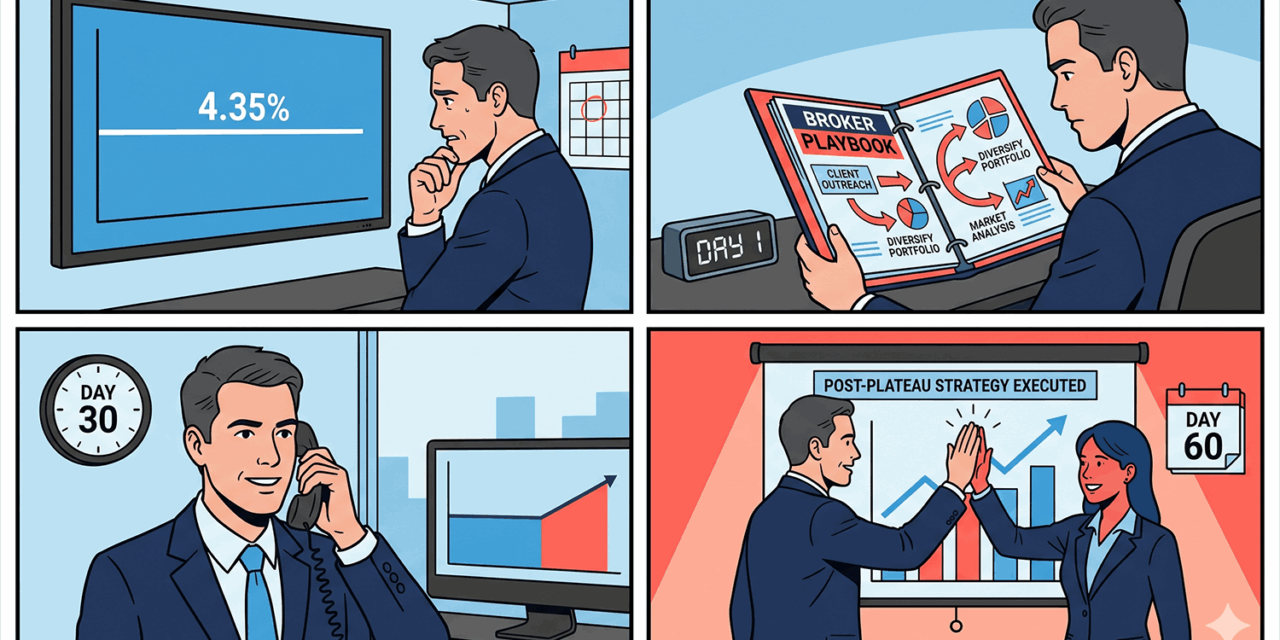
This audio version covers: The 4.35% Plateau: Your Post-Hold Broker Playbook for the Next 60 Days

In this guide
What the Hold Actually Signals
The RBA’s June decision wasn’t a surprise to most economists — market pricing had moved firmly toward a hold in the days before June 16. But the significance isn’t just that rates didn’t move; it’s what the hold tells us about the trajectory from here.
NAB economists have publicly reversed their earlier forecast for an August hike, now projecting that the next cash rate movement will be down. Their chief economist noted “greater conviction that the next move is down, but less conviction on timing.” ANZ and Westpac, meanwhile, are forecasting a meaningful slowdown in mortgage credit growth through financial year 2027, with property price growth moderating sharply in the major capitals.
Why It Matters
This matters for brokers because it reframes the conversation with clients. We’re no longer in a “how many more hikes?” environment. We’re in a “when does the cycle turn?” environment — and those two questions generate entirely different client anxieties, and entirely different broker opportunities.
The hold also lands against a backdrop of genuine rate competition among lenders. Despite the RBA not moving in June, Canstar data shows 11 lenders — including ING, BOQ, Community First, and Queensland Country Bank — independently cut at least one variable rate in the weeks leading up to the decision. More than 40 lenders now have at least one variable product sitting below 6%. This isn’t altruism; it’s lenders fighting for new borrower flow in a market where applications slowed during the hike cycle.
What Borrowers Are Feeling Right Now
It’s easy to underestimate how rattled three hikes in four months left borrowers. Roy Morgan data shows that as of May 2026, approximately 26.6% of mortgage holders were at risk of mortgage stress — roughly 1.38 million households. For many of these clients, the hold on June 16 was the first piece of good news they’d received since January.
But a hold isn’t a cut. Repayments at 4.35% are still significantly higher than where many fixed-rate loans were written in 2021 and 2022. The fixed rate roll-off cycle isn’t finished either — a substantial cohort of borrowers on fixed rates from that era are still transitioning to variable in the coming quarters, hitting rates that can be 2–3 percentage points higher than their original fixed term.
Key Concept
Brokers who understand this psychological dynamic — clients who feel relief but haven’t actually had any financial relief — are positioned to have genuinely valuable conversations right now. Relief is not resolution. A client who felt anxious about a fourth hike is still paying 4.35%. That’s still your job.
The Broker Opportunity in a Rate Plateau
A hold period, especially one the market expects to lead into a cut cycle, creates a specific set of opportunities for proactive brokers. Here’s how to think about each segment of your pipeline.
Your Back Book: The Rate Check Window
The period immediately following a hold is when back book outreach hits hardest. Clients who were told “rates might go higher” during the hike cycle and stayed put are now in a different headspace. They’re not afraid of timing an exit poorly — the next move is expected to be down, not up.
This is your moment to run a proper rate review across your back book. With 40+ lenders now under 6% on at least one variable product, and lender competition intensifying for new flow, refinancing clients to a sharper rate now — before cuts arrive and lenders potentially tighten cashback or introductory offers — makes sense for many borrowers.
Key Concept
Under Best Interest Duty (BID), you need to be able to show that a recommendation to stay put or switch is genuinely in the client’s interest. Doing nothing without a documented review is the risky position.
Pre-Approval Pipeline: Reset the Clock
Clients who obtained pre-approvals during the hike cycle may be holding off on purchasing, waiting for rates to fall. Some of those pre-approvals are approaching or past their 90-day validity window. Others are still valid but were issued under serviceability calculations that may look different if a lender has independently adjusted its rates or assessment criteria since May.
A proactive call to every client in your pre-approval pipeline — to update their position, reconfirm serviceability, and check whether their purchase criteria have shifted — is both good compliance hygiene and good business development. Clients who get this call remember you when they finally move.
Fixed Rate Rollovers: Next Quarter’s Opportunity
Identify every client in your CRM rolling off a fixed rate in the July–September quarter. For these clients, the question isn’t just “which rate?” — it’s “fixed or variable now?” With NAB calling the next move as down, and economists broadly expecting the cut cycle to begin before mid-2027, the calculus on fixing again has shifted. Helping clients think through the fixed vs variable question in a thoughtful, documented way is exactly the kind of advice that earns referrals and satisfies your BID obligations.
First Home Buyers: The Moment Has Arrived
FHB clients who paused in 2025 waiting for rates to stabilise have now got their signal. The First Home Guarantee scheme (which removed income caps earlier this year) combined with a rate plateau and softening property prices in Sydney and Melbourne creates a window that many first home buyers will act on. If you haven’t reached out to FHB prospects who went quiet over the past 12 months, the week following a hold is a legitimate reason to reconnect.
The Compliance Angle You Can’t Ignore
ASIC’s Best Interest Duty review is underway, and one area of focus is whether brokers are conducting proactive reviews for existing clients — not just when clients call them. A hold period, where market conditions have materially shifted from the environment in which many loans were written, is exactly the kind of trigger that justifies a review.
Document every outreach. Note in your CRM when you called a client, what you discussed, and what action (if any) was recommended. If you recommend a client stays in their current product, record why. If the client declines a review, record that too. ASIC’s enforcement lens is increasingly focused on the quality of file notes, not just the outcome of a recommendation.
Key Concept
AFCA’s most recent Systemic Issues Insights Report, released just this week, reinforced this point from a complaints-handling perspective: problems most often arise not because a broker lacks a process, but because the process doesn’t play out consistently in practice. A rate plateau is the ideal moment to audit your own workflows — client communication protocols, pre-approval tracking, fixed-rate rollover scheduling — and make sure they actually work.
What to Tell Clients Who Ask “When Will Rates Fall?”
This is the question brokers will face most often over the next 60 days. Here’s a grounded way to frame it:
NAB — which most recently changed its forecast — expects the next move to be down, but hasn’t committed to a date. The August and September RBA meetings are the next two data points. Before either meeting, we’ll see the June quarter CPI print (late July) and the June labour force data. If inflation continues to moderate and employment softens further, that strengthens the case for a September or Q4 cut. If inflation proves stickier, the hold could extend through the rest of 2026.
Client Question: How to Respond
“We don’t know exactly when, but the direction has changed. What I can do is make sure you’re in the best product for your situation right now, and we’ll revisit when the data gives us clearer timing.” That’s not a cop-out. That’s exactly what BID looks like in practice.
Your 30-Day Post-Hold Checklist
Use the next four weeks to execute the following:
- Week 1 — Back Book Audit: Pull every client at a variable rate above 6.0%. Cross-reference against the current market. Identify who has 20%+ equity and a clean repayment history — these are your easiest refinance conversations.
- Week 2 — Pre-Approval Pipeline Review: Contact every client with an active or recently expired pre-approval. Confirm their position, reassess their serviceability under current lender policies, and document the conversation.
- Week 3 — Fixed Rate Rollover Outreach: Run a CRM search for clients rolling off fixed rates in Q3 2026. Schedule review calls for all of them before their rollover date.
- Week 4 — FHB Re-Engagement: Pull every FHB prospect from 2025 who didn’t proceed. Write a brief, non-salesy update — “conditions have stabilised, worth revisiting?” — and send it. Some of them are ready to move.
What Comes Next
The August 5 RBA meeting is the next major date. Before then, the June CPI print (due late July) will be the most important data point. Watch trimmed mean inflation — that’s what the RBA is focused on above all else.
Lender behaviour between now and August will also be telling. If more lenders independently cut variable rates despite the RBA holding, that’s a signal of softening credit demand and increasing competition for new flow. Brokers who understand their lender panel’s competitive positioning in this environment will be better placed to recommend the right product at the right time.
Key Takeaway
The hold at 4.35% is not the finish line. It’s a checkpoint. Brokers who treat it as a moment to sit back will find themselves behind when the cut cycle begins and clients start shopping aggressively. The ones who use this plateau to clean up their pipeline, deepen client relationships, and document their compliance posture will enter that cut cycle with momentum.
The Window is Open. Use It.
The RBA’s June 16 hold at 4.35% is less a pause and more a pivot point. Proactive brokers should use the next 30–60 days to work their back book, review pre-approvals, and prepare fixed-rate rollover clients for a market where the next rate move is expected to be down.
Explore More Broker Insights
Disclaimer: This article is for general information and professional development purposes only. It does not constitute legal, compliance, or financial advice. Brokers should consult their aggregator’s compliance team and, where required, seek independent legal advice regarding their obligations under the National Consumer Credit Protection Act 2009 and ASIC’s responsible lending guidelines.