

In this guide

What Exactly Is Being Banned?
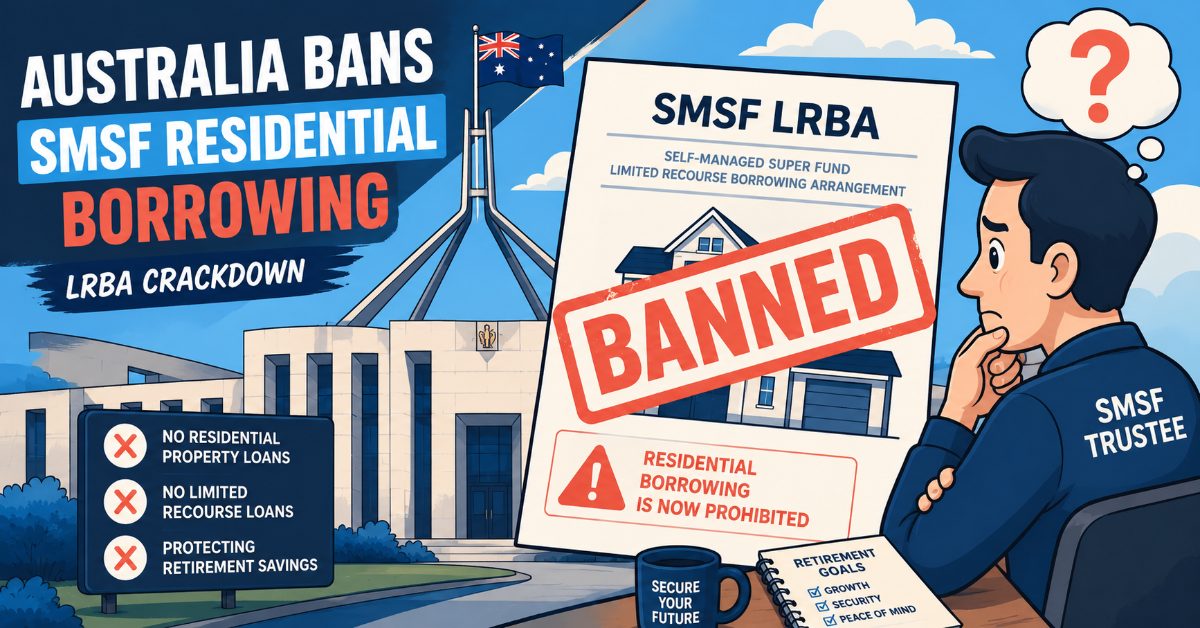
The amendment targets new LRBAs used to acquire residential property through an SMSF. Under the current framework established by the Superannuation Industry (Supervision) Act 1993 (SIS Act), SMSFs can borrow to purchase assets — including residential real estate — under a limited recourse borrowing arrangement. The asset is held in a bare trust until the loan is fully repaid, at which point it transfers into the SMSF.
Under the new rules:
- New residential LRBAs are prohibited from the commencement date. An SMSF trustee will not be able to enter into a new borrowing arrangement to purchase residential property.
- Existing arrangements are protected. If your client already holds a residential LRBA, or has exchanged contracts before the commencement date, they are grandfathered — even if settlement occurs after the ban takes effect.
- Commercial property is unaffected. SMSFs can continue to borrow to acquire commercial real estate under LRBA structures. This is a critical distinction for brokers to understand and communicate.
Refinancing of existing LRBAs appears to remain permissible under the current drafting, though the industry is seeking explicit confirmation from Treasury on this point.
The scope is narrower than some initial reporting suggested. This is not a blanket ban on SMSF borrowing. It is a targeted prohibition on new residential property acquisitions funded through LRBAs.
Why This Happened: The Political Mechanics
The LRBA ban was not part of the government’s original legislative agenda. The Treasury Laws Amendment (Tax Reform No. 1) Bill 2026 was designed to reform negative gearing and CGT discount rules — contentious enough on their own. But to secure passage through the Senate, the government needed Greens support, and the Greens have long argued that SMSF property borrowing inflates house prices and concentrates wealth.
The Greens’ position draws on recommendations from multiple reviews, including the 2014 Financial System Inquiry (Murray Inquiry), which recommended prohibiting SMSF borrowing on the basis that it introduced leverage risk into the superannuation system and could create systemic concerns. The Cooper Review before it raised similar flags.
From the government’s perspective, the LRBA ban was the least politically damaging concession available. SMSF residential lending is a niche product in the broader housing finance market, and the optics of restricting superannuation-funded property investment are less toxic than many alternatives the Greens could have demanded.
Why It Matters
Brokers with long memories will recall what happened in 2019 when then-Opposition Leader Bill Shorten floated a similar policy as part of Labor’s election platform. The policy never became law — Labor lost the election — but the market response was immediate and instructive.
All four major banks withdrew their SMSF residential lending products before any legislation was even drafted. The mere signal of regulatory intent was enough for credit risk committees to pull the pin. ANZ, CBA, NAB, and Westpac all exited the SMSF lending space within months of the policy announcement, and none have returned since.
That episode reshaped the SMSF lending market permanently. The major bank exit pushed borrowers toward non-bank and specialist lenders — names like Liberty, La Trobe Financial, Better Mortgage Management, and Thinktank — who continued to offer SMSF products, often at higher rates and with more conservative LVRs.
The lesson for today: do not assume you have until mid-August. Lender credit policy teams are already reviewing their positions. If you have clients with SMSF residential purchases in the pipeline, treat the next two to three weeks as your real window.
What Brokers Should Be Doing Right Now
This is not a theoretical compliance issue. It has immediate, practical consequences for broker businesses. Here is what you should be actioning today.
1. Audit Your SMSF Pipeline
Pull every SMSF residential deal currently in your pipeline. Identify where each one sits in the process: pre-approval, formal approval, exchange, or settlement. Any deal that has not reached exchange of contracts before the commencement date is at risk.
For deals that are close but not yet exchanged, talk to your clients and their solicitors about accelerating timelines. The grandfathering protection attaches at exchange, not at loan approval, so a formal approval from a lender is not enough on its own.
2. Have the Conversation With Clients Now
Your Best Interest Duty under the National Consumer Credit Protection Act 2009 (NCCP Act) requires you to act in your client’s best interests. For SMSF clients who were considering a residential property purchase, that means having an honest conversation about the changing landscape — promptly, not reactively.
Key points to communicate:
- New residential LRBAs will be prohibited from approximately mid-August 2026.
- If they want to proceed, they need to exchange contracts before that date.
- Lenders may withdraw products before the legal deadline, based on the 2019 precedent.
- Existing LRBAs are protected and do not need to be unwound.
- Commercial property remains a viable SMSF borrowing option.
Document these conversations thoroughly. ASIC has consistently emphasised that brokers must demonstrate they have provided appropriate information to clients about material changes affecting their credit products. A file note of the discussion, the options presented, and the client’s decision is essential.
3. Check Lender Appetite — Daily
Do not assume today’s lending panel will be tomorrow’s. Contact your SMSF lending partners and ask directly whether they intend to continue accepting new applications through to the commencement date. Some lenders may impose soft cut-off dates — ceasing to accept new applications weeks before the legal ban — to avoid the operational risk of deals falling over mid-process.
If you are an MFAA or FBAA member, your industry body will be monitoring lender positions and publishing updates. Stay connected to those channels.
4. Understand the Grandfathering Rules
The transitional provisions are relatively straightforward, but the details matter:
- Exchange before commencement = protected. If contracts are exchanged before the 45th day after Royal Assent, the LRBA can proceed to settlement and the loan can be drawn down even after the ban takes effect.
- Existing LRBAs are unaffected. Clients who already hold a residential property through an LRBA structure do not need to sell, repay, or restructure. The ban is forward-looking only.
- Refinancing grey area. The current drafting does not explicitly address refinancing of existing LRBAs. The SMSF Association and industry bodies are seeking clarification from Treasury. Until that clarification arrives, advise caution and seek specialist legal input before committing to a refinancing strategy for existing LRBA clients.

The Commercial Property Opportunity
For brokers who have built part of their book around SMSF lending, the ban on residential LRBAs is undeniably disruptive. But it also creates a pivot opportunity that forward-thinking brokers should be positioning for now.
Commercial property LRBAs remain fully permissible. SMSFs can continue to borrow to acquire offices, retail premises, warehouses, and industrial property. For SMSF trustees who were attracted to property as a tangible, income-generating asset within their fund, commercial real estate remains an option — and in many cases, a superior one from a risk-adjusted return perspective.
Broker considerations for the commercial pivot:
- Upskill on commercial lending. If your experience has been predominantly residential, now is the time to invest in your commercial lending knowledge. Understand commercial valuation methodologies, lease analysis, and the different credit assessment frameworks lenders apply to commercial transactions.
- Build your commercial lender panel. Specialist commercial lenders — Thinktank, Liberty Commercial, La Trobe Financial, and others — have strong SMSF commercial propositions. Ensure you have accreditations and relationships in place.
- Related-party leasing. One of the genuine advantages of commercial property in an SMSF is the ability for a related party to lease the property from the fund — something prohibited for residential property. A business owner can purchase commercial premises through their SMSF and lease it back for their business operations. This remains a compelling strategy and a strong conversation starter with business-owner clients.
- Partner with SMSF specialists. The compliance overlay on SMSF commercial lending is significant. Build relationships with SMSF-specialist accountants and financial advisers who can provide the superannuation and taxation advice that sits outside your credit licence. APRA and ASIC both expect clear role delineation — you provide the credit advice, the SMSF specialist provides the super advice.
Industry Bodies Are Fighting Back
Both the Mortgage & Finance Association of Australia (MFAA) and the Finance Brokers Association of Australia (FBAA) have publicly opposed the LRBA ban. Their core argument: the ban removes a legitimate wealth-creation tool from self-funded retirees without evidence that SMSF residential lending contributes meaningfully to housing affordability pressures.
The SMSF Association has been particularly vocal, pointing out that SMSF residential property holdings represent a tiny fraction of the total residential property market and that the compliance and cost barriers already limit SMSF borrowing to larger, well-resourced funds.
Whether the industry push succeeds in modifying the legislation remains to be seen. The political dynamics — the government needs Greens votes to pass its broader tax reform package — make a reversal unlikely before the bill passes. Post-election, in a different parliamentary configuration, the issue may be revisited. But for practical planning purposes, brokers should assume the ban will proceed as announced.
Key Concept
Periods of regulatory transition are exactly when compliance gaps tend to emerge. Keep the following front of mind:
- Best Interest Duty: Under section 158LA of the NCCP Act, you must act in the best interests of your client. For SMSF clients, this means proactively informing them of the ban, its timeline, and the implications for their investment strategy.
- Not unsuitable obligation: Beyond best interest, you must ensure any credit assistance you provide is not unsuitable for the client. An SMSF residential loan that cannot settle before the ban takes effect may well be unsuitable if there is a realistic risk the deal cannot complete.
- File notes: Document every client conversation about the LRBA ban, the options discussed, and the client’s instructions. If ASIC reviews your files retrospectively, your notes are your evidence that you met your obligations.
- Scope of advice: Remember that your Australian Credit Licence authorises you to provide credit advice, not superannuation advice. If a client asks whether they should use their SMSF to buy property at all, refer them to a licensed financial adviser. Do not stray beyond your lane, even with the best intentions.
The Bigger Picture
The LRBA ban is one component of a broader regulatory shift affecting property investment in Australia. The Tax Reform No. 1 Bill also changes negative gearing and CGT discount rules, which will reshape investor behaviour across the entire property market — not just the SMSF segment.
For brokers, the consistent theme is that the regulatory environment around property investment is tightening. The winners will be brokers who stay ahead of the changes, maintain strong compliance practices, and position themselves as trusted advisers who help clients navigate complexity rather than simply processing applications.
Key Concept
Key Takeaways for Brokers
- New SMSF residential LRBAs will be banned from approximately mid-August 2026.
- Lenders may withdraw products before the legal deadline — treat the next few weeks as your real window.
- Existing LRBAs and deals exchanged before commencement are grandfathered.
- Commercial property LRBAs remain fully available — position for the pivot now.
- Document all client conversations about the ban and comply with your Best Interest Duty.
- Stay in your lane: credit advice yes, superannuation advice no. Refer to licensed SMSF specialists.
Navigate the Shift: Secure Your SMSF Pipeline and Pivot to Commercial
The SMSF residential lending market is closing, but the commercial lending market remains open and offers significant opportunities. Brokers who proactively adapt, upskill, and position themselves as trusted advisers will not only retain their SMSF client base but also continue to grow in this evolving landscape.
Explore Commercial Lending Opportunities