
Too Busy to Read? We’ve Got You.
Get this blog post’s insights delivered in a quick audio format — all in under 10 minutes.
This audio version covers: Fixed Rates Already Priced the Hike: Reframing Fixed-vs-Variable Before the RBA’s 16 June Call

In this guide
What just happened
Westpac last week hiked its fixed home-loan rates by up to 0.45 percentage points, taking its cheapest two-year fixed rate to 6.14 per cent and making it the final Big Four bank to move. ANZ had already lifted fixed rates by up to 0.40 points, and CBA and NAB repriced earlier. Beyond the majors, Macquarie, Bendigo, ING and Bank of Queensland have all pushed fixed rates higher.
According to Canstar analysis reported in early June, more than 60 lenders have lifted at least one fixed rate since the RBA’s March decision. That is not a handful of outliers reacting to a single bank — it is the entire fixed-rate market moving in one direction, and doing it before the cash rate has changed again.
The backdrop is a tightening cycle that has caught a lot of borrowers off guard. The RBA has now raised the cash rate three times in 2026 — in February (3.60 to 3.85 per cent), March (3.85 to 4.10 per cent) and May (4.10 to 4.35 per cent) — returning the rate to its prior cycle peak and cementing the Bank’s status as a global outlier while most central banks ease. The next decision lands on Tuesday, 16 June at 2:30pm AEST.
Why fixed rates moved before the RBA did
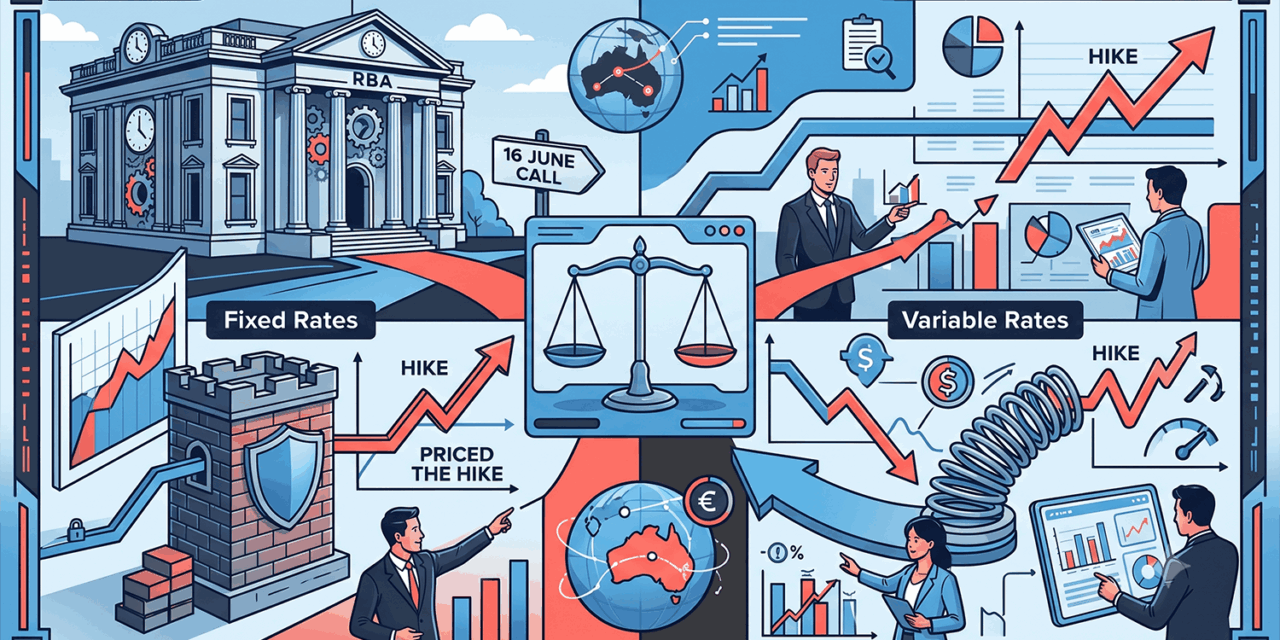
This is the part worth slowing down on, because it is the key to the client conversation. Fixed rates are not priced off today’s cash rate. They are priced off the market’s expectation of where the cash rate will sit over the life of the fixed term — the swap curve. When lenders lift two- and three-year fixed rates while the cash rate is still sitting at 4.35 per cent, they are telling you what wholesale funding markets already believe: that more tightening is coming, or at least that the risk of it is real enough to fund against.
The forecasts bear that out. Westpac’s economists are the only Big Four team currently tipping further hikes — two more 25-point moves in June and August that would take the cash rate to 4.85 per cent. ANZ, CBA and NAB have shifted to a hold call for June, pending more data. A Reuters survey of 31 economists found just over half expect the cash rate to hold at 4.35 per cent through the rest of 2026, while more than a third see at least one more increase. Markets are not pricing certainty — they are pricing risk. And the fixed-rate sheet your clients are looking at has already baked that risk in.
Key Concept
A fixed rate today is not a discount on variable — it is the price of insurance against a hike the market thinks is more likely than not. Sell it as certainty, not as savings.
What this means for the fixed-versus-variable conversation
For most of the last 18 months, the broker’s fixed-versus-variable script has been straightforward: variable is cheaper and more flexible, fixed only makes sense for clients who need certainty. That script breaks down when fixed rates have already climbed above variable and the cash rate itself looks like it could keep rising. The conversation now has to separate two questions clients tend to blur together.
The first question is direction: will rates go higher? Nobody, including the broker, knows. But the client does not need a forecast to make a decision — they need to understand that the fixed rate on offer already assumes the answer is “probably yes.” If the RBA hikes in June and August exactly as Westpac expects, a borrower who fixed last week will look smart. If the RBA holds, that same borrower will have paid a premium for certainty they did not strictly need. Both outcomes are reasonable; the borrower is choosing which regret they can live with.
The second question is tolerance: can the household absorb two more 25-point increases on a variable rate without distress? That is a serviceability and cash-flow question, not a market-timing one, and it is the one brokers are best placed to answer with actual numbers from the client’s file. Roy Morgan modelling after the May hike put around 1.6 million Australians — roughly 30 per cent of mortgage holders — in mortgage stress. For a household already close to the line, the certainty of a fixed repayment can be worth the premium even if rates ultimately hold. For a household with comfortable buffers, variable plus an offset may still win.
Run the file, not the forecast
The strongest position a broker can take this week is to stop debating where rates are going and start modelling what each path does to the client in front of them. A simple three-scenario table — rates hold, one more hike, two more hikes — mapped against the client’s monthly repayment and remaining buffer turns an anxious “should I fix?” into a decision the client can own. It also creates a documented, Best Interest Duty–aligned record of the options you presented and why.
Why It Matters: Serviceability Impact
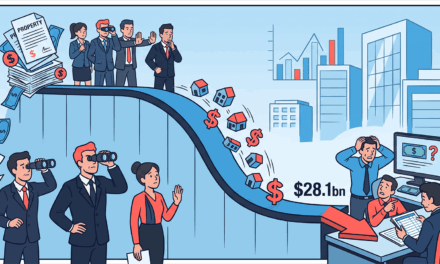
Remember the serviceability mechanics underneath all of this. Lenders still assess borrowing capacity at the contracted rate plus APRA’s 3 per cent buffer, which remains unchanged. Each 25-point hike pushes the assessment rate up in lock-step, and the cumulative effect of the three 2026 hikes has stripped roughly $50,000 to $60,000 of borrowing capacity from a couple on a combined $180,000 income. For pre-approval clients and anyone mid-purchase, that erosion is the more urgent story than the fixed-rate sheet — capacity written three months ago may no longer hold.
The refinance angle hasn’t closed — it’s shifted
Rising rates do not kill the refinance conversation; they change what it is for. Refinancing will not let a client escape the cash-rate cycle — that is passed through across the market — but lenders compete most aggressively for refinance volume in the days immediately after an RBA decision, and a better discount margin on a variable rate can offset a chunk of the next hike. With the broker channel writing record volumes — AFG brokers lodged $62 billion in the six months to December and now originate roughly one in nine of all Australian mortgages — the clients most exposed to repayment shock are disproportionately sitting in broker books. That is the pipeline to work before 16 June, not after.
What to review this week
- Pull every pre-approval issued in the last 90 days and re-check serviceability against current assessment rates — flag any that no longer hold before the client finds out at settlement.
- Identify variable clients within 12 months of a fixed-rate roll-off and model their position under hold, one-hike and two-hike scenarios.
- For clients asking to fix, frame it explicitly as buying certainty against a priced-in risk — document the trade-off, not just the rate.
- Build a refinance shortlist now so you can move the day after the 16 June decision, when discount competition peaks.
- Proactively contact your most leveraged households before the decision, not after the repayment notice lands.
What to watch next
The 16 June decision is the obvious marker, but the more telling signal will be what lenders do with fixed rates after it. If the RBA holds and fixed rates start drifting back down, that tells you funding markets have pulled their hike expectations — and the clients who fixed last week paid for insurance they will not collect on. If the RBA hikes and fixed rates climb again, the repricing is not over. Either way, the brokers who came into this week with their pipeline modelled and their high-risk clients already contacted will be the ones writing business while everyone else is still reading the rate-tracker headlines.
Your Role: Clarity, Not Forecasts
The fixed-rate market has already told you what it thinks. Your job is not to agree or disagree with it — it is to make sure every client understands the bet they are being asked to take, and can live with whichever way it lands.
Explore More Broker Resources
Disclaimer: This article is for general information and professional development purposes only. It does not constitute legal, compliance, or financial advice. Brokers should consult their aggregator’s compliance team and, where required, seek independent advice regarding their obligations under the National Consumer Credit Protection Act 2009 and ASIC’s responsible lending guidelines. Rate figures cited reflect reporting at the time of writing and are subject to change.