

Too Busy to Read? We’ve Got You.
Get this blog post’s insights delivered in a quick audio format — all in under 10 minutes.
This audio version covers: The Gatekeeper Obligation and July 2026 AML Compliance
The Gatekeeper Obligation and July 2026 AML Compliance
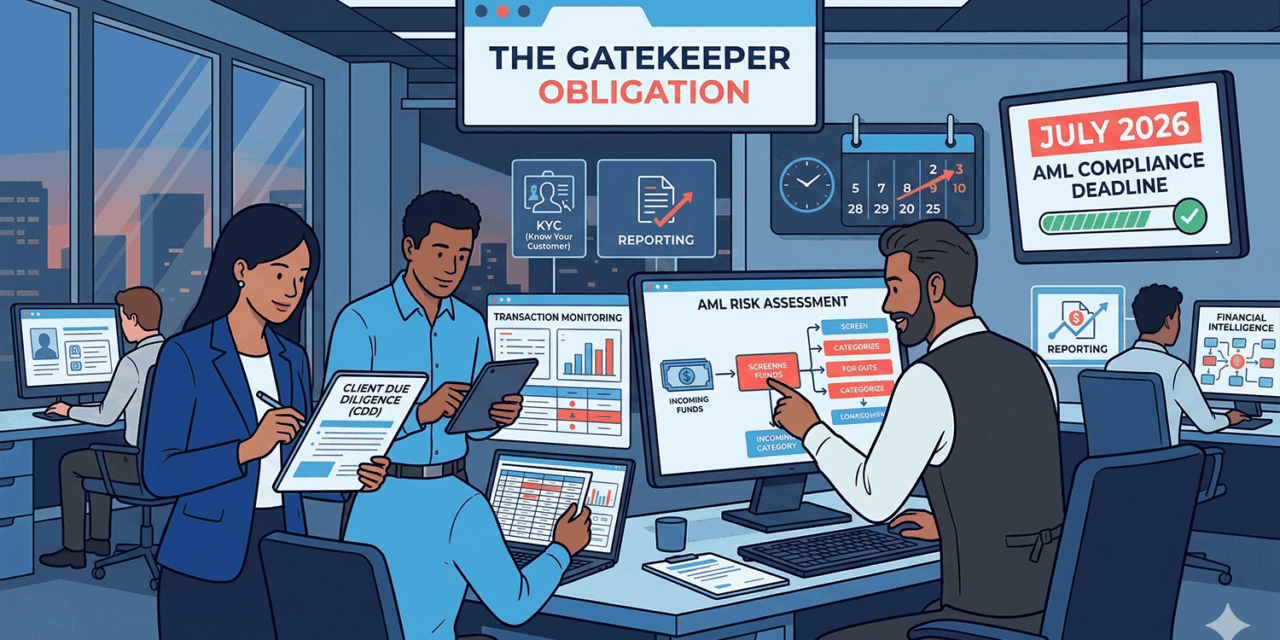
A watershed moment for the profession occurs on July 1, 2026. With the implementation of Tranche 2 Anti-Money Laundering and Counter-Terrorism Financing (AML/CTF) reforms, mortgage brokers are now officially classified as “gatekeeper” professions.
This transforms the broker from a pure transaction facilitator into a frontline detector of financial crime, placing the industry on par with lawyers, accountants, and real estate agents in the eyes of federal regulators.
In this briefing:
Step 1: The Designated Services Model
The core of the new regulation revolves around **Table 6 of the Professional Services regulation**. Under this model, AML/CTF obligations are triggered by “designated services.” For mortgage brokers, this primarily includes assisting in the planning or execution of transactions involving debt financing for corporate entities or legal arrangements.
Why Table 6 Matters
If your practice assists in structuring finance for trusts, shelf companies, or body corporates, you are likely providing a Table 6 service. This moves the KYC (Know Your Customer) requirement from a lender policy checkbox to a **statutory obligation** with significant legal weight.
Step 2: Beneficial Ownership Verification
A primary focus for AUSTRAC in 2026 will be the identification and verification of the **”beneficial owner”**. In complex structures—such as family trusts or multi-layered corporate groups—brokers must drill down to find the natural person who ultimately owns or controls 25% or more of the entity.
Compliance Tip: Manual verification is becoming a high-risk strategy. Leading firms are now auditing their “Gap Analysis” to identify where current data collection falls short of the upcoming beneficial owner verification standards.
Step 3: Navigating the Tipping-Off Trap
Perhaps the most challenging operational shift is the **”tipping-off” provision**. Under the new laws, it is a criminal offense to inform a client that they have been reported to AUSTRAC for suspicious activity (via a Suspicious Matter Report or SMR). This creates a delicate situation when a broker must withdraw services without alerting the client to the regulatory trigger.
“Based on our internal risk assessment and commercial policy, we are unable to proceed with this engagement at this time. Our engagement letter allows for discretionary termination where transactions fall outside our current risk appetite.”
Note: Avoid mentioning AUSTRAC, SMRs, or specific suspicions to avoid criminal liability for tipping off.
Step 4: The 2026 Compliance Roadmap
Waiting for the July deadline is a “poor strategy.” Brokers should begin their Gap Analysis now, appoint an AML Compliance Officer, and review Professional Indemnity (PI) insurance to ensure coverage for these new regulatory risks.
| Requirement | Deadline | Action for Brokers | Penalty |
|---|---|---|---|
| AUSTRAC Enrolment | 31 Mar – 29 Jul 2026 | Mandatory registration | Failure to enrol fines |
| AML/CTF Program Ops | 1 July 2026 | Risk-tailored manual | Up to $50M (Serious) |
| KYC/CDD Implementation | 1 July 2026 | Verify beneficial owners | Statutory breach |
| SMR Reporting | Ongoing from July ’26 | Report suspicious matters | Criminal offense |
Disclaimer: This article provides general educational information and is not a substitute for legal advice. Consult with a compliance specialist regarding your specific AML/CTF obligations.