

Too Busy to Read? We’ve Got You.
Get this blog post’s insights delivered in a quick audio format — all in under 10 minutes.
This audio version covers: Investor Lending Reset: Lenders Diverge on Negative Gearing, Retrospective CGT Scrapped — Requalify Now

Key Takeaways
- Calculators have already changed. Westpac and ORDE Financial are the latest to reset servicing after the Treasury Laws Amendment (Tax Reform No. 1) Bill 2026 passed on 25 June — even though the negative gearing rules don’t bite until 1 July 2027.
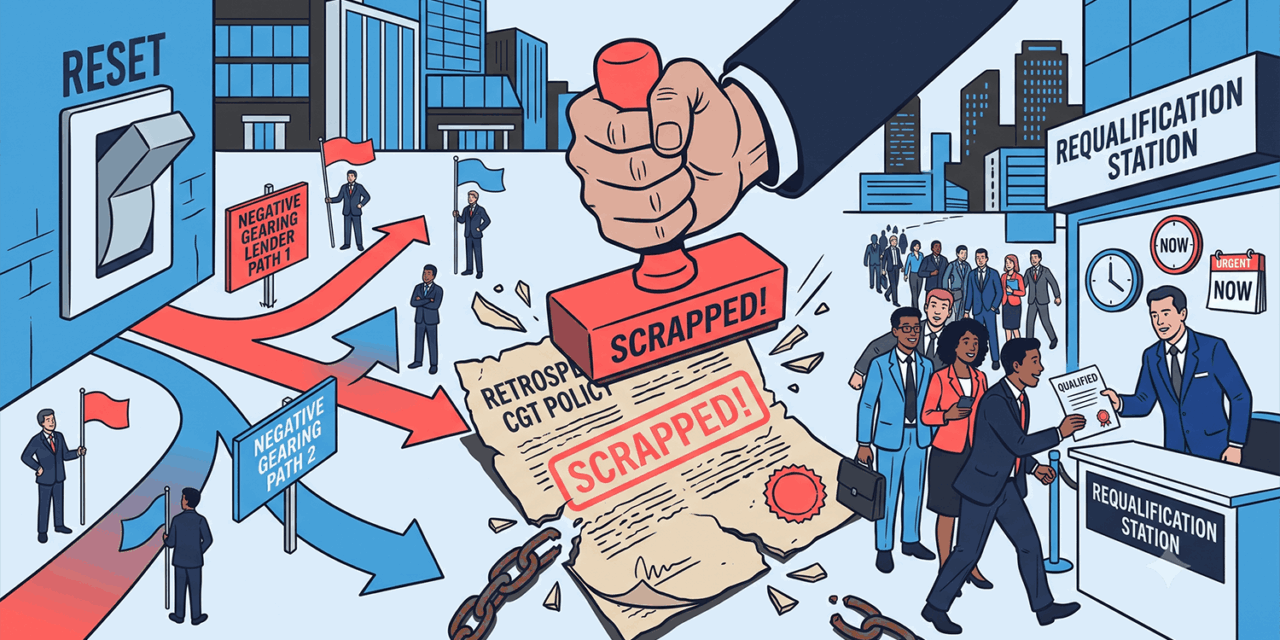
- The retrospective CGT scare is off. The government has dropped the backdated foreign-resident CGT provisions that reached to 2006 — but the broader regime is still widening, and the domestic negative gearing/CGT changes remain law.
- Divergence is real. Lenders moved on different dates with different eligibility tests, so the same investor can qualify for materially different amounts depending on whose calculator you use.
- 12 May 2026 is the hinge. Eligibility now turns on acquisition and contract-of-sale dates around budget night, not just the client’s income.
- Requalify now, document harder. With policy in flux, your Best Interests Duty file must show why this lender and structure suit this client.
In this guide
- What’s actually new this cycle
- The CGT retrospective backdown, decoded
- Calculators are being reset right now
- The lender-by-lender divergence
- The transition window you can still use
- The investor requalification playbook
- What to tell investor clients this week
- Why BID makes documentation non-negotiable
What’s actually new this cycle
You already know the shape of the negative gearing and CGT overhaul — it became law this year and has been dissected exhaustively. Park that. The fresh story is what’s happened since the Treasury Laws Amendment (Tax Reform No. 1) Bill 2026 cleared the Senate on 25 June, and it hits your pipeline in two places.
First, lenders aren’t waiting: they’ve reprogrammed their calculators to strip negative gearing add-backs for borrowers who won’t be eligible under the new rules — despite those rules not starting until 1 July 2027. Second, the government has walked back the retrospective element of its foreign-resident CGT changes after an industry campaign. One tightens capacity; the other restores confidence. Both change the conversation you should be having this week.
The CGT retrospective backdown, decoded
Here’s the part that matters — and that brokers keep getting slightly wrong. The government has removed the retrospective provisions from its foreign-resident CGT package: clauses that would have applied the new treatment to transactions dating back as far as 12 December 2006.
Why It Matters
Many affected foreign investors never lodged Australian returns for those older deals (reasonably, since the assets weren’t taxable then), so the usual four-year limit on reopening past tax matters wouldn’t have applied — leaving nearly two decades of disposals theoretically open to review. The Property Council led the pushback; the government blinked.
“This policy pivot is a win for commonsense … Applying new tax rules to transactions completed two decades ago would have spooked the international investors we need to help build tomorrow’s Australia.” — Mike Zorbas, Property Council of Australia (via Australian Broker)
Key Concept
What it is not: a wind-back of the whole CGT agenda. The foreign-resident regime is still expanding — the “real property” definition has been widened to capture more infrastructure and energy assets — and the domestic negative gearing and CGT reforms remain law. So don’t let a client leave thinking “the CGT changes are gone.” The accurate message is narrower: the look-back-to-2006 risk on foreign-resident disposals is off the table, which matters for anyone dealing with foreign-resident vendors or offshore capital.
Calculators are being reset right now
This is where the rubber meets the road. Westpac and ORDE Financial are the most recent to move, and their policies show how granular it’s become.
Westpac
- Updated credit policy applies from 29 June.
- Brokers must now distinguish between negative gearing and rental income tax deductions (RITD) — they’re no longer one bucket.
- Every new application is first assessed on whether the client can service the loan without negative gearing or RITD; only where a deduction is genuinely required do you run the updated calculator.
- Mandatory process: document the client conversation in ApplyOnline and complete declarations confirming the acquisition date, eligibility, and that independent tax advice was recommended.
ORDE Financial
- From 29 June, any loan not yet unconditionally approved is subject to a negative gearing eligibility test.
- The calculator now lets you flag whether a specific property or debt is eligible, with guidance across scenarios — established purchases, refinances, cash-out, owner-occ-to-investment conversions, new builds and commercial.
- Established investment purchases stay eligible where the contract of sale was executed before 12 May 2026; commercial purchases, refinances and equity releases used to buy commercial property (or income-producing shares) also remain eligible.
The common thread: the tax benefit is being limited on investment properties acquired after 7:30pm AEST on 12 May 2026 — budget night.
The lender-by-lender divergence
Don’t assume the panel is moving in lockstep, because it isn’t. The sequence tells the story:
- Macquarie moved first, stripping most negative gearing add-backs on 18 May.
- Great Southern Bank followed on 21 May.
- NAB and Connective Horizon on 26 May.
- Suncorp from 27 May; ANZ from 28 May; CBA rewired its calc on 28 May.
- ING moved on 15 June with its own transitional arrangements.
- Westpac and ORDE brought up the rear from 29 June.
Different dates, different transitional treatment, different carve-outs for commercial, cash-out and new-build. The headline for brokers is blunt: the same investor can now qualify for materially different amounts depending on which lender you assess. The incumbent that gave your client their best number in March may now be mid-pack — or the sharpest. You won’t know until you re-run it.
The transition window you can still use
The rules don’t legally bite until 1 July 2027, but the calculators have already changed. In practice the hinge for a given deal is two things: the acquisition or contract date relative to 12 May 2026, and whether the application is unconditionally approved before the relevant lender’s cut-off. That creates a genuine window — but it’s not simply a race:
- Eligible existing holdings — broadly, contracts executed before 12 May 2026 — largely retain their negative gearing treatment in servicing.
- New purchases after budget night generally lose the add-back, so those clients need requalifying on the tighter number now, not on 30 June 2027.
- Pipeline deals not yet unconditionally approved are being pulled onto the new framework as each lender’s date passes — a file that serviced last month may not service today.
The investor requalification playbook
A concrete, do-it-this-week sequence for your investor book:
- Triage the pipeline. Pull every investor file that isn’t yet unconditionally approved — the ones exposed to a lender flipping mid-deal.
- Re-run servicing across the panel. With lenders diverging, treat last year’s preferred lender as an assumption to be tested, not a default.
- Pin down the dates. Establish the acquisition and contract-of-sale date for each security — pre or post 12 May 2026 is now the eligibility hinge.
- Separate negative gearing from RITD. Following Westpac’s lead, assess whether the client services without the add-back first, then layer eligible deductions only where policy allows.
- Check SMSF and LRBA exposure. The bill banned new limited recourse borrowing arrangements (LRBAs) for residential property inside SMSFs; the FBAA is urging brokers to requalify any SMSF resi strategy fast.
- Recommend independent tax advice — in writing. Lenders such as Westpac now require a declaration that you did. Make it standard on every investor file.
- Re-date your evidence. A March servicing calc is stale. Refresh it, note the lender policy version, and diarise a review before long-dated pre-approvals lapse.
What to tell investor clients this week
Keep it short, and get in first — before they read a half-story online and panic:
Borrowing Power Update
“Your borrowing power may have moved even though your situation hasn’t.” Lenders have changed how they count negative gearing, so we need to requalify you on today’s numbers.
CGT Retrospective Update
“The retrospective CGT scare is off the table.” The backdated foreign-resident provisions have been dropped — relevant if you’re buying from a foreign-resident vendor or have offshore capital in play.
Lender Assessment Timeline
“The change bites from 1 July 2027, but lenders are already assessing as if it’s here.” If you’re buying, eligible deals get better treatment now — subject to your acquisition dates.
Existing Properties
“Your existing eligible properties are largely unaffected.” Broadly, contracts before 12 May 2026 keep their current treatment.
Professional Advice
“Talk to your accountant, and we’ll document everything.” This is a tax-driven change: we structure the finance, your tax adviser confirms the position.
Why BID makes documentation non-negotiable
ASIC Compliance Note
A thin file can survive stable policy. When it’s in flux and lenders are openly diverging, it can’t. Under your Best Interests Duty and ASIC’s RG 273, you must show why the recommended lender and structure serve this client — not just that the rate looked sharp.
With the same borrower qualifying for different amounts across the panel, the “why this lender” reasoning is the whole ballgame. Your file should capture:
- The servicing comparison across relevant lenders and why the chosen one fits — capacity, eligibility carve-outs, transitional treatment.
- The acquisition and contract dates relied on, and the eligibility conclusion that flowed from them.
- That you recommended independent tax advice, and the client’s response.
- Your responsible-lending assessment under the NCCP, including the APRA serviceability buffer applied.
None of this is gold-plating. It’s the difference between a recommendation you can defend in twelve months and one you can’t.
The Bottom Line
The negative gearing rules are a 2027 event, but the broker impact is right now. Calculators have been rewired, lenders have moved on their own timetables, and the retrospective foreign-resident CGT threat has been pulled. Investor borrowing capacity is genuinely a moving target, and the broker who assumes last year’s number still holds is exposed. Requalify the book, lead the client conversation before they lead it, and write the “why” down — the brokers who requalify early and document properly keep placing deals while everyone else is still reading the fine print.
Stay Ahead: Subscribe to TheBrokerTimes for more insights
Sources: Broker Daily — More lenders revise servicing policies after tax reforms pass, Australian Broker — Government scraps retrospective CGT rules after industry pushback, Australian Broker — More lenders tighten investor lending rules ahead of tax shake-up, Australian Broker — NAB tightens lending ahead of tax shake-up
Disclaimer: This article is for general information and professional development purposes only. It does not constitute legal, compliance, or financial advice. Brokers should consult their aggregator’s compliance team and, where required, seek independent legal advice regarding their obligations under the National Consumer Credit Protection Act 2009 and ASIC’s responsible lending guidelines.






The retrospective CGT scare being scrapped is a relief, but domestic reforms remain. Investors need to assess the real impact on borrowing capacity. Clear Tax works with clients to ensure tax strategy aligns with lending and long-term investment goals.