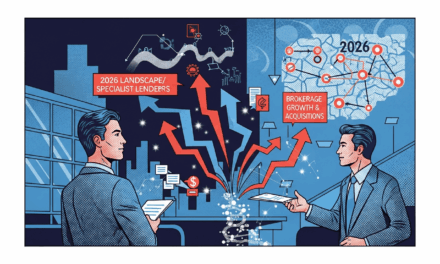

Too Busy to Read? We’ve Got You.
Get this blog post’s insights delivered in a quick audio format — all in under 10 minutes.
This audio version covers: The Trust Lending Freeze
The Trust Lending Freeze
Which lenders have pulled back, which haven’t, and how to restructure your pipeline before it costs your clients — and your conversion rate.
Major lenders including Macquarie have paused or significantly restricted new home loans to trusts and companies in 2026. Brokers with investor-heavy books are being caught off guard mid-application. This article maps the lender landscape, explains the risk triggers, and gives you a practical framework.
Why Lenders Are Pulling Back
The trust lending freeze of 2026 isn’t a single event — it’s the product of two compounding pressures that have been building for some time, and finally tipped lenders into pulling back.
The first is compliance complexity. Trust structures — family trusts, unit trusts, self-managed superannuation funds — carry layered legal and tax obligations that require lenders to conduct significantly more verification work than a standard residential application. Under current regulatory conditions, the cost and risk of that assessment is causing credit teams to reassess whether the business is worth taking on.
The second is structured, social media–driven strategies. A growing number of borrowing arrangements are appearing in lenders’ pipelines that appear designed specifically to exploit trust structures for tax minimisation or asset protection purposes — strategies that are often promoted by online “investment educators” and social media creators. Lenders’ compliance teams have flagged these structures as higher risk, and credit policy has followed.
When a lender’s compliance team identifies a pattern of applications linked to a specific strategy or structure, it often triggers a policy-level review — which can result in a category-wide pause, regardless of whether individual applications are actually problematic.
The 2026 Lender Landscape
The current lender landscape is not uniform — but it’s changing faster than most brokers’ intelligence is keeping up with. Broadly, lenders have split into three tiers.
New trust and company applications have been fully paused. Macquarie is the most prominent example cited in 2026. Do not submit to these lenders without first confirming current policy status directly.
A number of lenders are still accepting trust and company applications, but with stricter documentation requirements, elevated scrutiny, and longer assessment timelines. Expect additional verification requests and allow more time in your pipeline planning.
A smaller group of lenders has held their trust lending policy steady and is actively welcoming this business. These should be your first port of call for new trust applications in 2026 — identify and build relationships with their BDMs now.
The lender you successfully used for a trust deal six months ago may not be the right lender today. Assuming availability without confirming current policy status can cost your client — and your pipeline — weeks of wasted time.
Risk Triggers to Know
Not all trust applications are being treated equally. Certain patterns are drawing extra scrutiny — or triggering outright declines — across multiple lenders. Brokers need to identify these risk factors before lodging.
- → SMSF or complex trust structures with multiple beneficiaries and unclear income trails
- → Company borrower applications where the structure appears tax-motivated rather than operationally necessary
- → Client strategies that reference social media or online “investment educator” frameworks — explicitly or implicitly
- → High-volume investor portfolios held across multiple trust entities with rapid accumulation patterns
Your 3-Step Broker Framework
The brokers who will come out of this environment ahead are not the ones waiting to see what happens — they’re the ones who treat this as a process problem with a clear solution. Here is the framework.
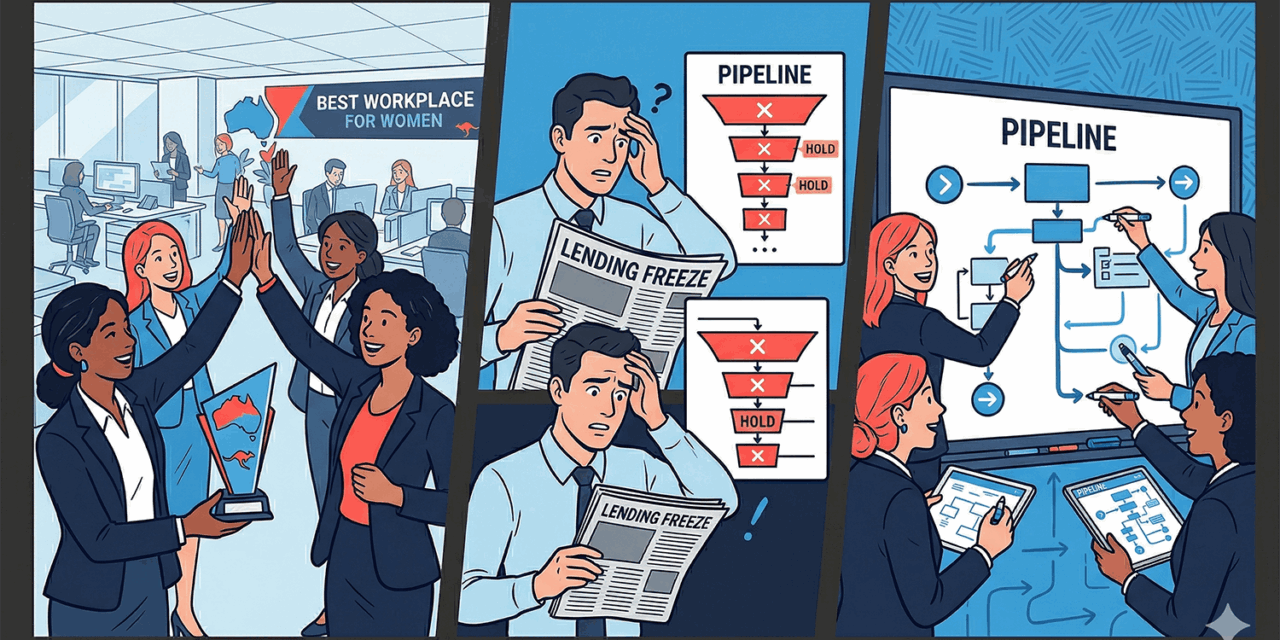
Map Your Current Pipeline
Audit every trust or company application currently in progress. For each deal, confirm the lender’s current policy status — don’t assume. If you have applications lodged with lenders who have since paused, prioritise those conversations immediately.
Re-Engage Clients Early
The conversation needs to happen before the credit assessment — not after a decline. Explain the current landscape clearly. Avoid alarmism, but be honest. A client who hears about this from you first is far easier to manage than one who hears about it from a lender decline letter.
Restructure Where Necessary
In some cases, a trust deal can be restructured into a personal name borrowing arrangement without significantly compromising the client’s goals — and without the compliance burden. In others, the right answer is simply identifying a lender who is still actively taking this business. Either way, knowing your options before you’re forced to choose puts you in control.
The Client Conversation
Knowing what’s happening in the lender landscape is only useful if you can translate it into a conversation your clients can understand and act on.
The framing that works best is this: the rules of the game have changed, and my job is to make sure we’re playing by the new ones before we get caught out. This positions you as the expert who is ahead of the market — not reacting to it.
- Lender policy on trust borrowing has shifted in 2026 — this is industry-wide, not specific to you or your situation.
- We need to confirm which lenders are still actively taking this type of application before we proceed.
- In some cases, the best path forward may be a different structure or a different lender — I’ll walk you through the options.
- The goal is the same: getting your deal done efficiently and with the best outcome. We just need to navigate a different route.
Key Takeaways
Major lenders including Macquarie have paused or restricted trust and company lending in 2026. Don’t assume your usual lender is still open.
Two drivers: compliance complexity with trust structures, and lender concern about socially-promoted structured strategies.
A smaller group of lenders is actively open for this business. Identify them and build BDM relationships now.
Map your pipeline, have the client conversation early, and restructure deals where needed. This is a process problem — solve it systematically.
Frequently Asked Questions
Policy changes of this type tend to be reassessed over time as lenders gauge the regulatory and compliance environment. However, for your immediate pipeline planning purposes, treat these restrictions as current policy until confirmed otherwise. Always verify directly with the lender’s BDM.
The restrictions are most pronounced for SMSFs, discretionary family trusts, and company borrower structures — particularly those that appear to have been set up primarily for tax or asset protection purposes. Some lenders may still accept simpler trust structures; check individual lender policy carefully.
Applications already in the system with lenders who have paused new trust lending may still be assessed — but you should contact the lender immediately to clarify. Do not proceed with new lodgements without confirming the lender’s current stance, as doing so risks a formal decline on file.
The most common restructure is moving to borrowing in personal names, particularly where the trust structure was not providing a significant tax or structural benefit. This should always be discussed with the client’s accountant or financial adviser before proceeding, as there may be flow-on implications for the client’s broader financial structure.
Stay ahead of policy shifts
Get the intelligence that keeps your pipeline moving. Join brokers across Australia reading TheBrokerTimes.