

Too Busy to Read? We’ve Got You.
Get this blog post’s insights delivered in a quick audio format — all in under 10 minutes.
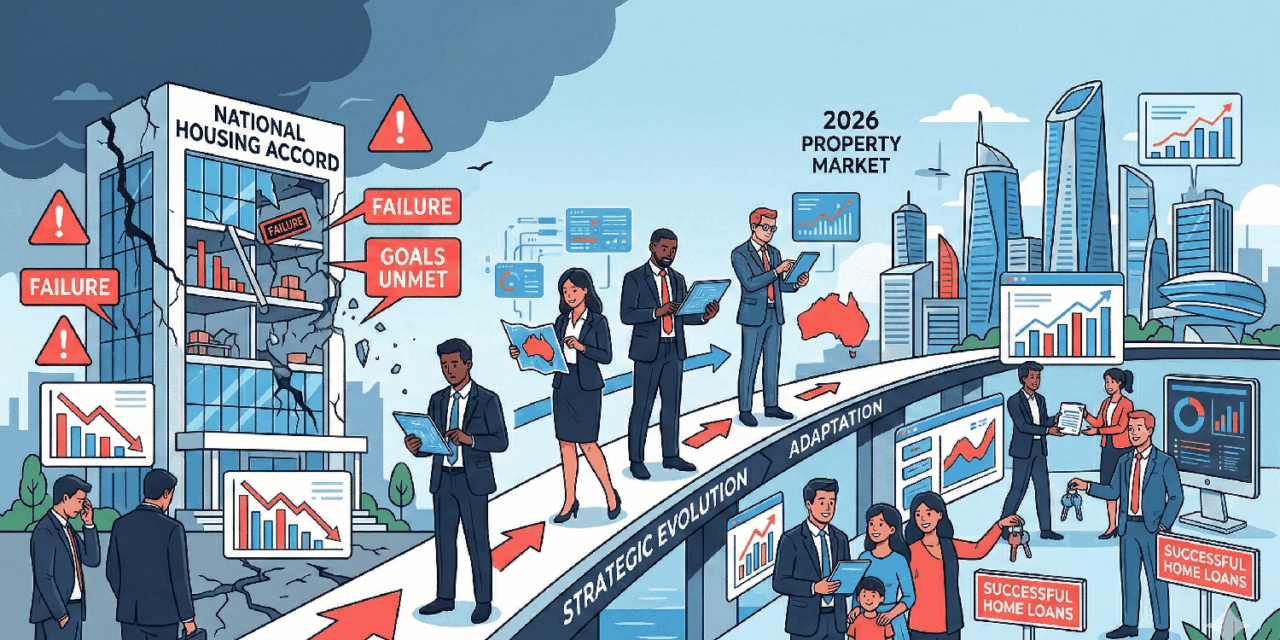
This audio version covers: The National Housing Accord Failure and the Strategic Evolution of Australian Mortgage Broking A Comprehensive Analysis of the 2026 Property Market
The National Housing Accord Failure and the Rentvesting Surge
The “Two-Speed” Australian property market has arrived. As the National Housing Accord’s target of 1.2 million homes falls 30% behind, a structural shortfall is now “baked into the system” for 2026. For brokers, this isn’t just a supply crisis—it’s a fundamental shift in how you must advise clients.
Australia’s ambitious plan to build 1.2 million new homes by 2029 is in significant trouble. Reports from the National Housing Supply and Affordability Council (NHSAC) confirm a projected shortfall of at least 262,000 homes, with independent analysts suggesting the deficit could reach 462,000 units by the decade’s end. This scarcity is the primary driver behind 2026’s forecast house price rise of 7.7% and unit price rise of 7.1%.
Inside This Briefing
Step 1: Analyzing the Supply Deficit
The failure of the National Housing Accord is driven by three persistent headwinds: labor shortages, elevated construction costs (up 31% cumulatively over five years), and planning delays. Small builders, who represent two-thirds of the industry, are facing immense pressure; 68% have considered scaling back or closing entirely due to excessive red tape.
Broker Insight: In 2026, “Execution” is the challenge, not loan growth. With vacancy rates remaining critically low at 1.1%, the rental crisis is effectively supporting current property valuations despite higher interest rates.
Step 2: 2026 Growth Hotspots
While Sydney and Melbourne grapple with affordability ceilings, mid-sized capitals are surging. Brisbane, Adelaide, Perth, and Darwin are all tipped for roughly 30% growth by 2030-31.
| Capital City | 2026 Median Value | Projected Growth | Key Advantage |
|---|---|---|---|
| Brisbane | $1.013 Million | 30% | Olympic infrastructure spend |
| Adelaide | $908,000 | 30% | Defence & Tech sector growth |
| Perth | $950,000 | 30% | Resource sector strength |
| Sydney | $1.24 Million | 25% | Most acute supply shortage |
*Source: 2026 Propertybuyer Report / ABS Data Analysis.
Step 3: The “Rentvesting” Strategy
With Sydney house prices projected to surpass $2.22 million, rentvesting has become a survival strategy for younger buyers. This involves renting in lifestyle-rich areas while purchasing investment assets in high-yield, affordable regional markets or units.
The “Investment-Grade” Checklist for 2026:
- Location Fundamentals: Proximity to “20-minute neighborhoods”.
- Scarcity: Established brick units (1960s-80s) selling below replacement cost.
- Rental Shading: Lenders typically only count 70% to 80% of rental income for serviceability.
Step 4: Navigating APRA’s New DTI Limits
From 1 February 2026, APRA implemented a new debt-to-income (DTI) cap. Banks are limited to writing only 20% of new mortgages at a DTI ratio of 6:1 or higher. This specifically targets portfolio investors.
“I understand the bank has hit its high-DTI quota for this quarter. However, there is a strategic opening: loans for new dwellings and construction are currently exempt from the APRA DTI cap. We can also explore non-bank lenders like Pepper or Liberty, who are not subject to these same APRA restrictions, ensuring we keep your portfolio momentum intact.”
Strengthen Your Broker Strategy Today
The 2026 editorial takeaway is clear: housing scarcity is a permanent feature of the current cycle. Brokers must pivot from loan volume to becoming strategic advisors on yield, DTI management, and regional growth corridors.
Download the 2026 Broker Strategy Guide