
Too Busy to Read? We’ve Got You.
Get this blog post’s insights delivered in a quick audio format — all in under 10 minutes.
This audio version covers: The Hai Money Lesson: A Sub-Aggregator Due Diligence Framework Every Principal Broker Needs by Q3 2026

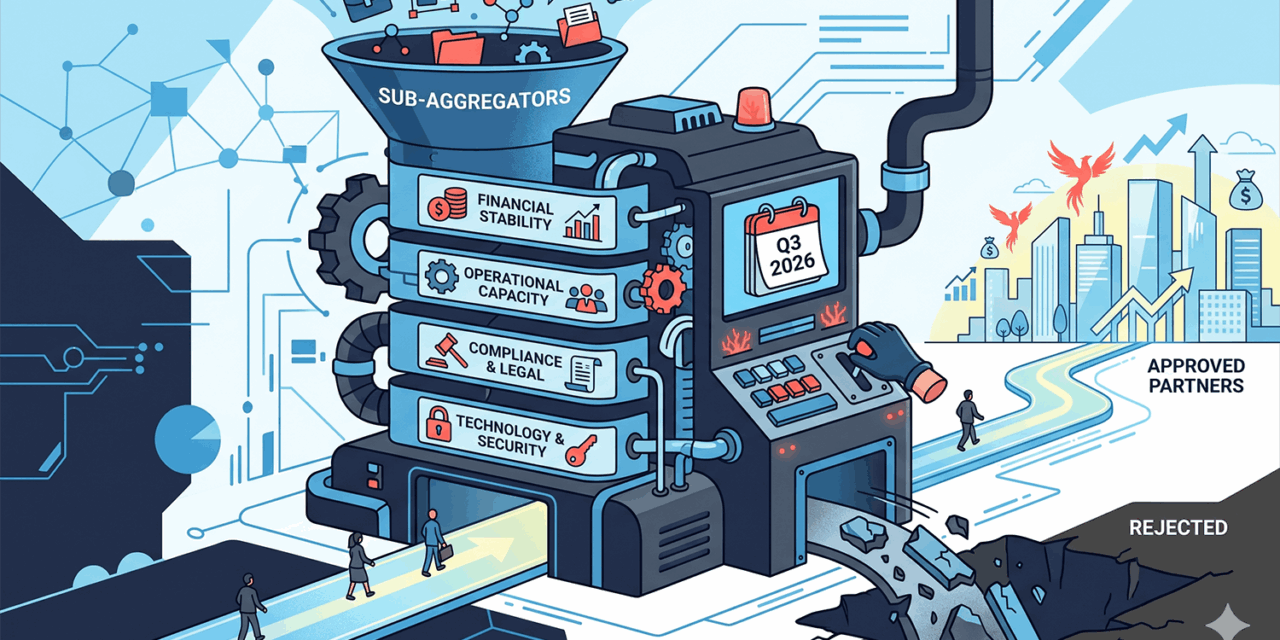
Sub-Aggregator Due Diligence
The Hai Money Framework
A four-phase model every principal broker should apply before Q3 2026.
Assets restrained by the NSW Crime Commission
Penthouse Syndicate members charged
Federal Court injunction freezing Finsure termination
National aggregators reviewed in ASIC BID exam
Four-Phase Framework
Onboarding Due Diligence
ASIC criminal history, bankruptcy search, two prior aggregator references, lender accreditation evidence, signed acknowledgement of file standards.
Ongoing Supervision
Monthly 10% file sampling, quarterly BID commentary review, documented escalation, individual ACR commission visibility.
Pattern Detection
Geographic clusters, repeat valuers and accountants, document metadata anomalies, unexplained pre-application deposits.
Offboarding & Exit
Trail book reconciliation, file transfer with privacy controls, timely aggregator notification, formal closing letter.
Three documents to pull this week: your aggregator agreement, every ACR contract, and the supervision log for the past 12 months. If any is stale, that is the first thing to fix.
Interactive Tool
Sub-Aggregator Readiness Self-Assessment
Tick what your brokerage can demonstrate today. Your readiness score appears at the bottom.
The Hai Money Lesson: A Sub-Aggregator Due Diligence Framework Every Principal Broker Needs by Q3 2026
The Federal Court’s 15 May interim injunction freezing Finsure’s attempt to terminate its sub-aggregation agreement with Hai Money has done more than pause a contractual dispute. It has put a flashlight on a structural exposure that every principal broker running authorised credit representatives — and every aggregator running a sub-aggregator panel — should be re-examining this quarter.
The facts of the dispute itself are still being argued. Hai Money, on the evidence before Justice Kate Williams, has a strong case. Finsure, for its part, has argued that systemic failure within a sub-aggregator’s broker network is sufficient grounds to terminate. What is not in dispute is that brokers operating under a head licence carry liability that flows up the chain — and that liability has just become highly visible to ASIC, AUSTRAC, and every aggregator’s general counsel.
For principal brokers and brokerage owners, the Hai Money case is the cleanest possible prompt to test something most have not stress-tested: the due diligence framework you apply when bringing on, supervising, and offboarding the brokers operating under your licence.
What the Hai Money case actually tells brokers
The most important takeaway is not about fraud. It is about contractual exposure. Hai Money was not personally accused of misconduct. The allegations sit with brokers in its network — brokers connected to the so-called Penthouse Syndicate matter that has now grown to involve more than twenty-five charged individuals and roughly $95 million in restrained assets under the NSW Crime Commission. Yet Hai Money’s entire commercial relationship with Finsure was placed at risk on the basis of broker conduct it did not personally engage in.
Brokers who run authorised credit representatives sit in the same structural position Hai Money does. Your aggregator agreement almost certainly contains language allowing termination for breaches by individual ACRs. ASIC’s Best Interests Duty review — which the MFAA’s Looking Ahead 2026 event confirmed is now scrutinising aggregator supervision frameworks — has put aggregator boards under pressure to act faster and harder when broker conduct creates regulatory exposure.
The result is a tighter, more aggressive enforcement environment within aggregator networks. Termination will not be reserved for proven fraud. It will increasingly be applied where supervision is judged inadequate. That is the lesson Hai Money offers, and it is one every principal should respond to before an aggregator’s compliance team raises a concern of their own.
Why this matters now, not in twelve months
Three converging pressures make this an immediate priority rather than a long-term watching brief.
First, the ASIC BID review will produce its practice standards report this year. Aggregator supervision frameworks are being assessed against that standard. Brokerages operating under those aggregators will be expected to demonstrate that they have inherited and applied the same standards to their own ACRs.
Second, the broader fraud environment has shifted. Commonwealth Bank’s self-reported $1 billion exposure to suspected fraud involving AI-generated documents has triggered enhanced lender governance across the broker channel. CBA has tightened its loan referral program, banks are publishing new onboarding standards, and AUSTRAC has called in ten lenders to share fraud data. Sub-aggregators and principals are now being evaluated as part of a lender’s source-of-business risk profile.
Third, the Best Interests Duty review has confirmed that documentation, not intent, is what ASIC measures. The regulator examined samples of recommendations made by brokers across six national aggregators and reviewed how each aggregator monitored and supervised those brokers. Where supervision was thin, that finding will flow downstream.
The principal broker due diligence framework
Every principal broker operating ACRs under their head licence should be able to demonstrate a documented framework across four phases. The framework below is a practical starting point that can be adapted to the size of your brokerage. None of it is novel — most of it sits in your aggregator’s PDS already — but few brokerages have it consolidated into a single, auditable artefact.
Phase 1 — Onboarding due diligence
Before authorising any new ACR, you should have on file: a current ASIC criminal history check, a bankruptcy and director-of-failed-company search, references from two prior aggregators or employers (with documented call notes), proof of current accreditation with the lenders the ACR will write to, and a signed acknowledgement that they have read your file note standards and BID commentary template.
A surprising number of principals operate on the assumption that the aggregator’s onboarding process is sufficient. It is not. The aggregator vets the credit representative against its own commercial criteria. You are vetting them against your own regulatory exposure, which is narrower and more personal.
Phase 2 — Ongoing supervision
The expected supervision standard for an ACR working under a head licence has lifted materially in the past eighteen months. At minimum, principals should commit to: a monthly file sampling review covering at least 10% of submitted files (with documented findings), quarterly one-on-one BID commentary review for each ACR, a documented escalation process for ACRs flagged twice on the same file quality issue, and visibility on commission, cashback, and lender-incentive activity at the individual ACR level.
Sampling matters more than total volume. ASIC’s BID review specifically examined how aggregators assured themselves that broker recommendations met the standard. A principal who can show six months of sampled file reviews with documented coaching outcomes is in a defensible position. A principal who cannot is not.
Phase 3 — Pattern detection
The Penthouse Syndicate matter has changed the threshold for what counts as a credible warning sign. Specific patterns that should now trigger immediate review include: clusters of files from the same suburb or property type, repeat use of the same accountants, conveyancers, or valuers across unrelated borrowers, payslips and bank statements that share unusual formatting or metadata characteristics, unexplained cash deposits in the eight weeks preceding application, and any ACR running materially higher cashback or rebate offers than network peers.
None of these patterns prove anything in isolation. Together, they form the kind of profile that lender fraud teams now flag automatically. A principal who detects them first is in a better position than one who learns about them through a clawback letter.
Phase 4 — Offboarding and exit
This is the phase most brokerages handle worst. When an ACR leaves — voluntarily or otherwise — the principal should have a documented checklist covering: trail book accounting and clawback exposure, transfer or retention of client files (with privacy controls), notification to the aggregator within the contractually required window, and a formal closing letter to the ACR confirming the end date and post-termination obligations.
If a regulator later raises a question about a file written by a departed ACR, the principal’s defence rests largely on this paper trail. Without it, you are explaining without evidence.
What to review this week
For a practical entry point, pick three documents from your filing system and confirm the following: your aggregator agreement (locate and read the termination clauses — specifically the language around broker conduct, indemnities, and clawback), your ACR agreements (confirm they mirror the obligations your aggregator has imposed on you), and your supervision log (confirm that the most recent twelve months show consistent sampling activity).
If any of those documents are missing, out of date, or inconsistent, that is the first thing to fix. The rest of the framework can be built around them in 60 to 90 days.
The strategic significance
The Hai Money case will be argued, settled, or appealed over the coming months. The legal outcome will matter to the parties involved. The operational outcome — that every aggregator board now understands it can act on broker conduct, and will be expected to act faster when it does — already applies to every principal broker in the channel.
The principals who treat the next 90 days as a window to formalise their due diligence framework will not just reduce regulatory exposure. They will become more attractive to aggregators that are themselves under pressure to demonstrate supervision quality. In a market where aggregator selection is becoming a two-way conversation, that is a commercial asset, not just a compliance task.
Conclusion
Hai Money will not be the last sub-aggregator dispute of 2026. Brokers running ACRs under a head licence should treat the case as a prompt to consolidate the supervision practices most have been doing informally, into a documented framework they can produce on demand. The framework does not need to be perfect. It needs to exist, to be applied consistently, and to be reviewed quarterly. Aggregators are being held to that standard. Principals will be, too.
Disclaimer: This article is for general information and professional development purposes only. It does not constitute legal, compliance, or financial advice. Brokers should consult their aggregator’s compliance team and, where required, seek independent legal advice regarding their obligations under the National Consumer Credit Protection Act 2009 and ASIC’s responsible lending guidelines.