

Too Busy to Read? We’ve Got You.
Get this blog post’s insights delivered in a quick audio format — all in under 10 minutes.
This audio version covers: Beyond Data Entry How Offshore Processing Partners are Achieving 40% Faster Settlement Times
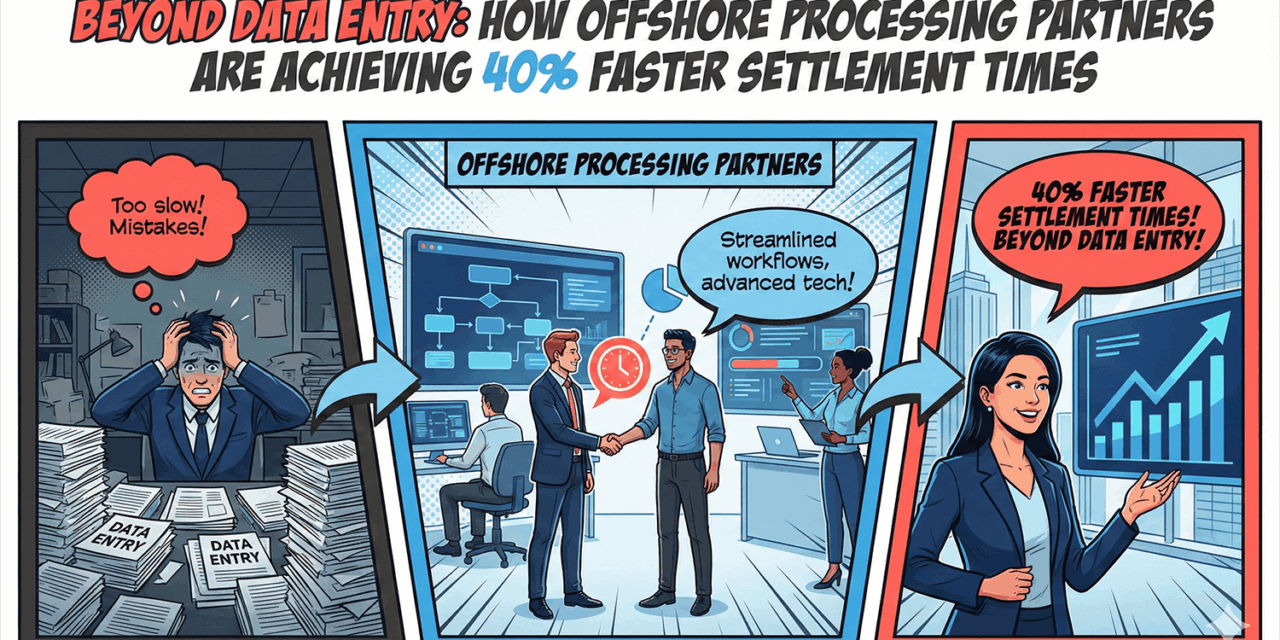
Beyond Data Entry: How Offshore “Processing Partners” are Achieving 40% Faster Settlement Times
Article Roadmap
1. The Structural Transformation of 2026
The Australian economy in early 2026 presents a “digital paradox”: sophisticated lending portals coexist with increasingly non-standard borrower profiles. National house prices continue to grow—forecast at 7.7% for houses and 7.1% for units [4]—while interest rates remain at restrictive levels near 3.6%.[1]
| 2026 Metric | Benchmark | Broker Implication |
|---|---|---|
| Broker Market Share | 77.3% – 78% | Dominance increases the need for scale.[1, 6] |
| RBA Cash Rate | 3.6% | Serviceability and repayment flexibility are critical.[1] |
| Contractor Workforce | 1.1 Million | Rising complexity in “Alt-Doc” income assessment.[5] |
| Industry Cost-per-Loan | $8,000+ | Automation is required for margin survivability.[7] |
2. The Economic Imperative: Manual vs. Automated
Manual processing—characterised by re-keying data and manual document cross-referencing—introduces structural risk. Industry data shows that manual document handling accounts for nearly two-thirds of total loan production costs.[7]
The Financial Reality
An in-house processor in Australia commands AUD $70,000–$90,000, while a trained offshore processor costs between AUD $18,000–$30,000.[8] Beyond wage arbitrage, offshore processing partners provide a 50% to 70% reduction in operational costs.[8]
3. Agentic AI: The New Processing Intelligence
The transition from legacy Optical Character Recognition (OCR) to “Agentic AI” is the driver behind the 40% speed boost. Traditional OCR pipelines achieved only 60-64% accuracy in complex files.[9, 10] By contrast, Agentic Intelligent Document Processing (IDP) uses Large Language Models (LLMs) to “read” and “understand” context.[9, 11]
4. The Evolution of the Offshore Role
By 2026, the offshore processing partner is an extension of the local team, handling everything from preliminary document audits to direct communication with lender Business Development Managers (BDMs).[12, 13]
| Support Task (Allowed) | Credit Advice (Prohibited) |
|---|---|
| Data entry into CRM/ApplyOnline [14] | Giving specific credit advice [14] |
| Serviceability calculations [14] | Making final loan recommendations [14] |
| Lender BDM follow-ups [12, 13] | Unsupervised client suitability talks [14] |
| Document indexing and audits [7, 14] | Signing off as a credit representative [14] |
5. The “Blended” Workforce Strategy
The definitive operating model for 2026 pairs fractional local leadership with offshore execution. This allows mid-market firms to access deep expertise in AI and compliance without hiring $300k+ full-time executives.[15, 16]
Cultural Synergy & Pitfalls
Cultural nuances matter. Offshore teams must be trained on the “human impact” of a settlement delay. Common pitfalls include the “MIR Trap”—where assessors follow rigid scripts and ignore broker notes, leading to avoidable delays.[17, 18]
Strategic Verdict for 2026
Success in 2026 will not be defined by who controls retail banking distribution, but by who helps borrowers navigate complexity.[5] By offloading the 60% of administrative burden to a processing partner, you can pivot to high-value advisory.
Strengthen Your Processing Strategy