

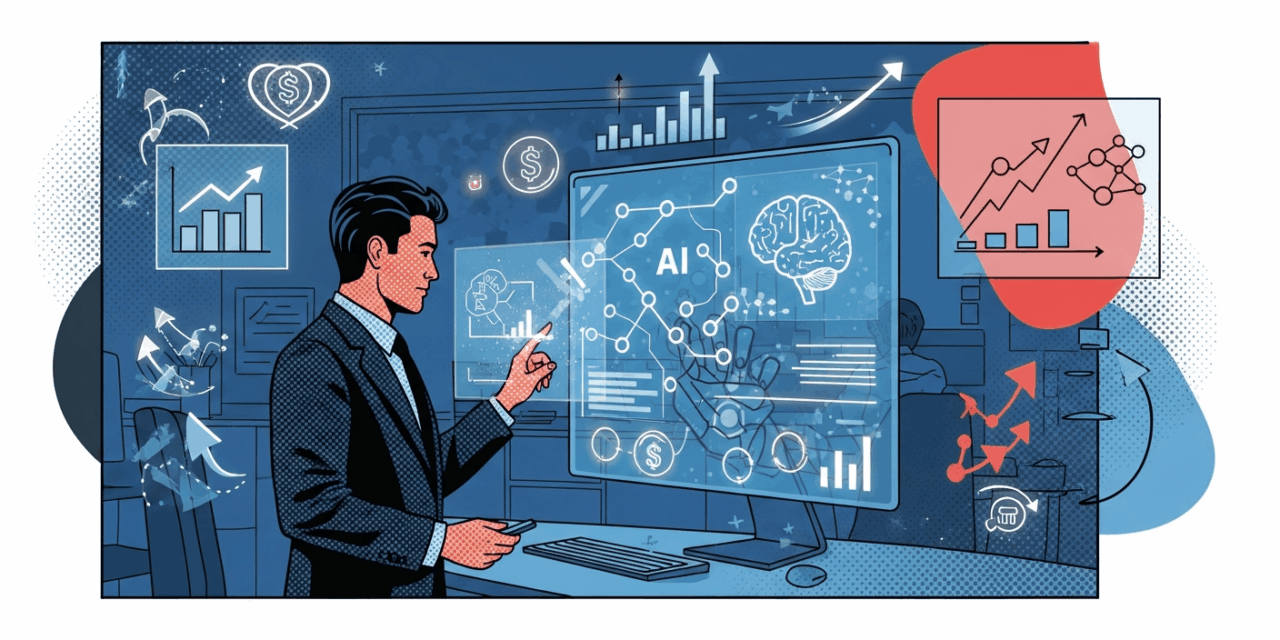
Within the next 3-5 years, sophisticated portfolio construction and financial advice will be available to every Australian at effectively zero marginal cost.

I’m not talking about robo-advice. I don’t mean rules-based rebalancing. I’m talking about genuine strategic wealth management, backed by the kind of advanced analytical capability that is currently only available to the few.
The technology enabling this shift—agentic AI —is already being deployed. OpenAI has assembled a specialized team under Project Mercury, hiring more than 100 former investment bankers from firms like Goldman Sachs and JPMorgan to train models specifically for complex financial analysis and IPO modeling. Major platforms are racing to integrate these autonomous portfolio management capabilities. The infrastructure is being built right now.
This isn’t ‘distant disruption’. It’s a soon-to-be existential crisis for the industry, as concepts of scarcity, value and expertise are redefined.
Inflection Point
Let’s be clear about what we’re discussing. Agentic AI systems reason, plan, and execute autonomously (within defined parameters). They don’t respond to prompts—they pursue objectives.
In terms of an objective such as wealth management, an AI agent might, for example, simultaneously analyse every listed security across multiple markets, construct efficient frontiers across thousands of scenarios, and generate bespoke portfolios calibrated to individual tax positions, ethical constraints, risk tolerances, and life-stage considerations. It isn’t portfolio modelling with a little personalisation at the edges—it’s genuinely individualised construction.
That same agent can also provide continuous portfolio oversight: monitoring positions, executing rebalancing within pre-approved parameters, harvesting tax losses opportunistically, generating regulatory documentation contemporaneously, and communicating material changes to clients with explanations calibrated to their financial literacy.
The unit economics here are nothing short of transformative. An agent managing a $50,000 portfolio requires the same computational overhead as one managing $5 million.
Suddenly, the constraint isn’t advisor capacity—it’s computation—and that fundamentally disrupts traditional pricing models across the wealth management industry.
Traditional Fee Models Break
The AUM-based model assumes portfolio construction expertise justifies ongoing fees. When that expertise becomes nearly free at the production level, what component of 60-80 basis points remains defensible? While regulatory oversight and “best interests” compliance still carry costs, the marginal cost of the technical advice itself is plummeting toward zero.
The fee-for-service model assumes advisor time as the binding constraint. When AI agents eliminate that constraint, hourly advice models face a “valuation trap.” Furthermore, AI recommendations can significantly mitigate traditional product bias; while no system is truly free of “algorithmic bias,” these agents move us closer to a world of structurally objective advice (rather than just disclosed conflicts).
Some advisors will respond by maintaining existing service models at compressed pricing. That’s competing on speed against something that operates 24/7, on consistency against something that never has a bad day. It’s not a sustainable position.
The Psychology of Denial
I’ve spent two decades helping organisations navigate technology-driven transformation. I’ve watched industries dismiss disruption until it was too late. Blockbuster, Kodak, the music industry, print media—they all said “that’ll never happen to us” right up until it did.
There’s often a denial phase. An uncomfortable truth people aren’t prepared to accept because it fundamentally challenges their mental model. Sometimes it’s arrogance: “We’re too important, too established, our relationships are too valuable.” Sometimes it’s just the human tendency to underestimate exponential change.
The financial advice industry is at that inflection point now.
What I’m seeing across transformation projects—not just in financial services, but across sectors—is a consistent pattern. When you present organisations with what AI can do, you get one of two reactions. The first group sees possibility. They’re curious, they want to experiment, they understand that early adoption means early learning. These are your evangelists.
The second group finds every reason why it won’t work. ‘The technology isn’t ready’. ‘The clients won’t accept it’. ‘Our situation is different’. These are your blockers. And the uncomfortable reality is that blockers aren’t just resisting the technology—they’re resisting the fundamental change to how they work and what makes them valuable.
The Path Forward
So what does survival look like? Some advisors will try to compete by serving more clients at lower fees. That’s racing to the bottom against infinitely scalable AI. You’re competing against systems with near-zero marginal cost. The math doesn’t work.
Others will go the opposite direction: dramatically fewer clients, substantially deeper relationships, fundamentally different value propositions. This isn’t about incremental change—it’s about complete repositioning.
What does that look like? It’s the advisor who can sit across the table during a market crisis and provide genuine support, not just analytical reassurance. It’s the advisor who builds relationships with a client’s accountant, lawyer, and business partners to provide truly integrated advice. It’s the advisor who helps a client think through whether they should fund their daughter’s business venture or help with a house deposit. Who can navigate family dynamics when an inheritance is involved. Who understands that money is rarely just about money—it’s about values, legacy, family relationships, identity, security.
It’s the advisor who charges, not based on portfolio size, but on the comprehensive, deeply personal service they provide. It’s a retainer model for life counsel that happens to involve financial expertise, not a percentage model for portfolio management that happens to include some personal attention.
AI can’t build trust through shared experience. It can’t exercise judgment in the grey areas where technical correctness and human wisdom diverge. It can’t understand that sometimes the “right” financial decision is wrong for this particular person at this particular moment in their life.
That’s the opportunity.
It’s not the technology that determines who wins and who loses. It’s the choices we make about that technology that’s the differentiator.
And those choices need to be made soon. Not in five years when the disruption is complete. Now, while you can shape your practice’s evolution rather than having it shaped for you.
The advisors who are building new models now—experimenting when it’s uncomfortable, willing to question fundamental assumptions about how advice is delivered and valued, accepting that the next five years will look nothing like the last twenty—those are the ones who’ll thrive.
The question isn’t whether this transformation happens. It’s already happening.
The advantage will go to those who move while others are still deliberating.
Get Broker Insights Delivered to You
Interested in learning more about how brokers are using smarter tools and strategies to work more efficiently? Register your details below and we’ll share relevant insights and next steps with you.